














HS Code Lookup for Heading 8546
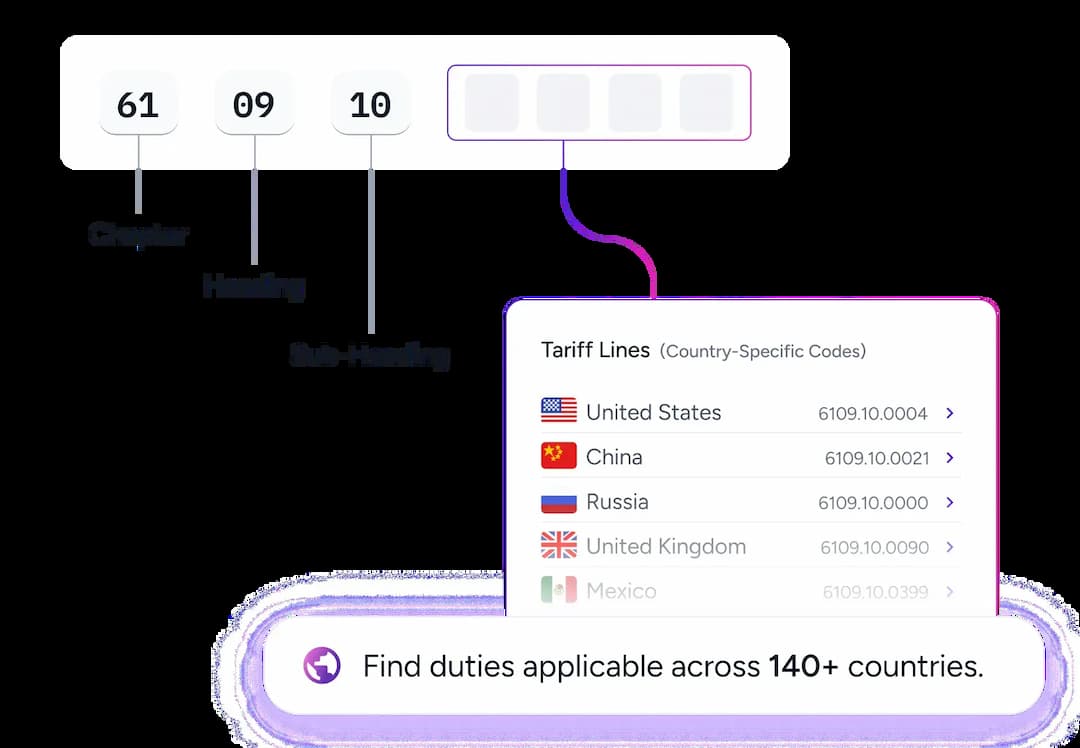
HS Code Lookup helps classify products under appropriate HS code and find duties applicable across 140+ countries. Find and discover HS classification, tariffs, taxes, controls, rulings, ECCNs, and default and preferential duties for HS code 8546.

WCO Notes for Heading 8546
85.46 ‑ Electrical insulators of any material.
8546.10 ‑ Of glass
8546.20 ‑ Of ceramics
8546.90 ‑ Other
Insulators of this heading are used for the fixing, supporting or guiding of electric current conductors while at the same time insulating them electrically from each other, from earth, etc. The heading excludes insulating fittings (other than insulators) for electrical machinery, appliances or equipment; these fittings fall in heading 85.47 if they consist wholly of insulating material (apart from any minor components of metal incorporated during moulding solely for purposes of assembly).
Usually there is a relation between the size of the insulator and the voltage (large for high voltages, smaller for low voltages). Similarly, the shape of the various types of insulators is influenced by electric, thermic and mechanical considerations. The external surface is very smooth in order to prevent the formation of deposits of non‑insulating materials, such as water, salts, dusts, oxides and smoke. Insulators are often given bell, accordion, petticoat, grooved, cylinder or other shapes. Certain types are constructed in such a way that when in position they may contain oil to prevent contamination of the surface by conducting materials.
Insulators may be made of any insulating material, usually very hard and non‑porous, e.g., ceramic material (porcelain, steatite), glass, fused basalt, hardened rubber, plastics or compounded insulating materials. They may contain fixing devices (e.g., metal brackets, screws, bolts, clips, laces, slings, pins, cross pieces, caps, rods, suspension or carrying clamps). Insulators equipped with metal horns or guard shields or other devices to form lightning arresters are excluded (heading 85.35).
Insulators are used on outdoor cables, e.g., in telecommunications, power networks, electrical traction systems (railway, tramway, trolleybus, etc.), and also for indoor installations or on certain machines and appliances.
The insulators of this heading include :
(A) Suspension insulators, such as :
(1) Chain suspension insulators. These are used mainly on outdoor networks, and consist of several insulating elements. The conductor cable or wire is fixed at the bottom of the assembly which is hung on a suitable support (pylon arm, suspension cable, etc.).
Suspension chain insulators include cap or hood type insulators, double petticoat insulators; chain link insulators; linked rod insulators.
(2) Other suspension insulators (e.g., insulators in the form of balls, bells, pulleys, etc.) for overhead lines of railways, trolleybuses, cranes, etc., or for aerials.
(B) Rigid insulators.
These may be fitted with supports (e.g., metal hooks, pins or the like); or they may be without supports, but intended to be attached to power or telegraph poles, etc., or fitted to walls, ceilings, floors, etc., by means of nails, screws, bolts, etc. Insulators with fixed supports may be built up of two or more elements; those without supports are usually single units. They may be of various shapes (e.g., bells, cones, cylinders, buttons, pulleys).
(C) Leading‑in insulators.
These are used for guiding cables or wires through walls, etc. They are of various forms (e.g., cone or double cone shaped insulators, disc insulators, sleeves, pipes and tubular bends).
The heading excludes insulated electrical conduit tubing and joints therefor (heading 85.47).

What is HS code 8546?

How many sub-headings are there in HS code 8546?
International Trade Compliance Simplified