














HS Code Lookup for Heading 9105
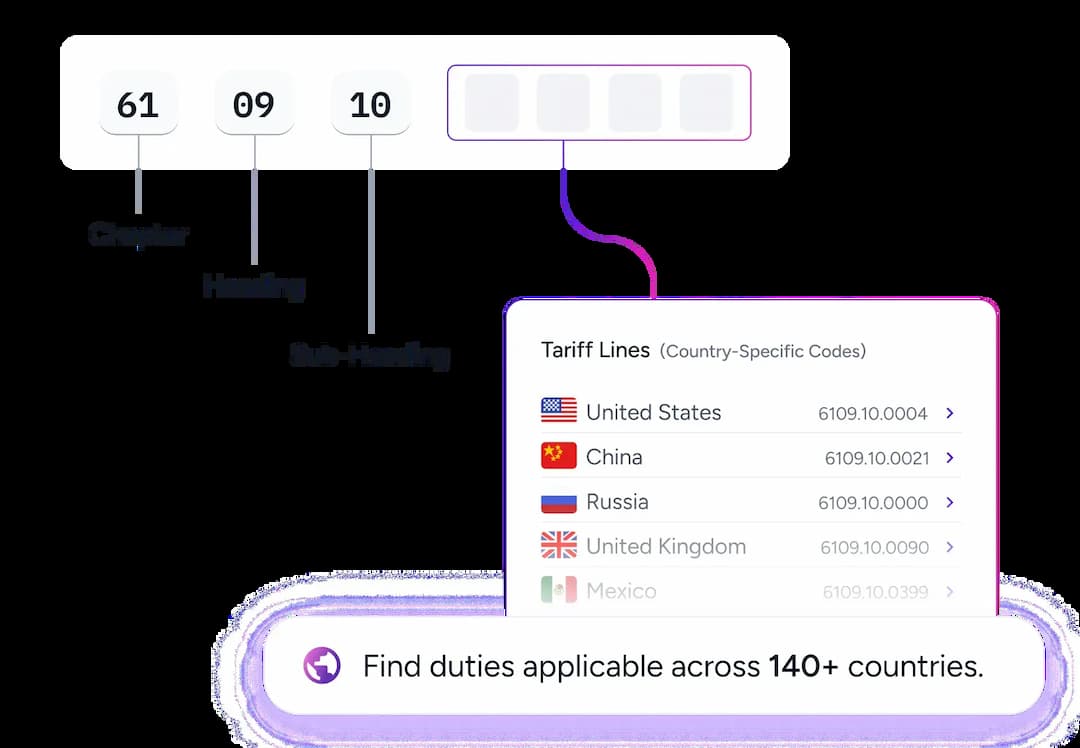
HS Code Lookup helps classify products under appropriate HS code and find duties applicable across 140+ countries. Find and discover HS classification, tariffs, taxes, controls, rulings, ECCNs, and default and preferential duties for HS code 9105.

WCO Notes for Heading 9105
91.05 ‑ Other clocks.
‑ Alarm clocks :
9105.11 ‑ ‑ Electrically operated
9105.19 ‑ ‑ Other
‑ Wall clocks :
9105.21 ‑ ‑ Electrically operated
9105.29 ‑ ‑ Other
‑ Other :
9105.91 ‑ ‑ Electrically operated
9105.99 ‑ ‑ Other
This heading covers timekeepers, not classified elsewhere in the Chapter, essentially constructed for indicating the time of day; they must, therefore, have movements other than watch movements. Clocks and alarm clocks with watch movements (as defined by Chapter Note 3) are excluded (heading 91.03).
The clocks classified here may be weight, spring, electrically or electronically operated; they are generally regulated by a pendulum, a balance‑wheel and hairspring, a tuning fork or a piezo‑electric quartz crystal. They are often equipped with a striking mechanism (hours, half‑hours, or quarters) acting on a bell or gong, or a multi‑gong chiming mechanism.
Subject to the above conditions, the heading includes :
Public clocks; clocks for shops, the home, etc.; period clocks; special regional forms of fancy clocks (Neuchâtel clocks, Paris clocks, cuckoo‑clocks, Westminster chiming clocks, etc.); “marionette” clocks; coin‑operated clocks; astronomical or observatory clocks; self‑winding clocks (wound, for example, by variations of temperature or atmospheric pressure); alarm clocks; centre‑seconds clocks; electronic clocks; piezo‑electric quartz crystal clocks.
The heading also includes clocks for electric clock systems as used in towns, factories, telephone exchanges, stations, airports, banks, hotels, schools, hospitals, etc. These systems consist of a precision‑regulated master clock and the secondary clocks which it drives by remote control. The master clock has usually a mechanical or electrical movement and a contact device for transmitting the driving impulses to the secondary clocks. The secondary clocks, indicating the hours and minutes, receive their driving impulses at the end of each minute or half‑minute. They have an electro‑magnet with a rotating or oscillating armature which actuates the train and the motion work; each impulse from the master clock advances the minute hand by one minute or half‑minute. The train may also be driven by an electrically wound spring or directly by an electric motor. Seconds‑indicating secondary clocks are provided with centre‑seconds hands in addition to the hour and minute hands. In this case, the master clock must have a special device emitting impulses each second, besides the minutes contact. It should, however, be noted that the heading excludes secondary clocks with only minute and seconds hands or with seconds hands alone (for regulating watches, etc.); these fall in heading 91.06.
Secondary clocks may be used indoors or outdoors, may have two or more dials, and may be designed for placing on a flat surface such as a table.
Master clocks sometimes control other electric appliances, such as time‑registers, watchmen’s tell‑tales, switching appliances, recorders, signals (bells, sirens, lamps), beacons or ground‑lights.
The heading also includes groups of mains‑driven synchronous clocks, and pneumatic installations operated by compressed air, used for relaying and synchronising time.
The heading also covers marine or similar chronometers, i.e., high precision stationary timepieces, mainly designed for keeping time on ships though some are also used for scientific purposes. These instruments are generally larger than chronometer watches and are fitted in boxes; they may or may not be mounted in gymbals. They usually run either two or eight days at one winding, and generally have a detent escapement, a fusee, a device for converting the force of the mainspring into constant pressure, and a working reserve indicator.
The heading excludes the following when presented separately : clock cases (heading 91.12), movements (heading 91.09 or 91.10) and parts of movements (generally heading 91.10 or 91.14).
The heading further excludes :
(a) Deck watches (heading 91.01 or 91.02).
(b) Instrument panel clocks and clocks of a similar type, for vehicles, aircraft, spacecraft or vessels (heading 91.04).

What is HS code 9105?

How many sub-headings are there in HS code 9105?
International Trade Compliance Simplified