















HS Code Lookup for Heading 9114
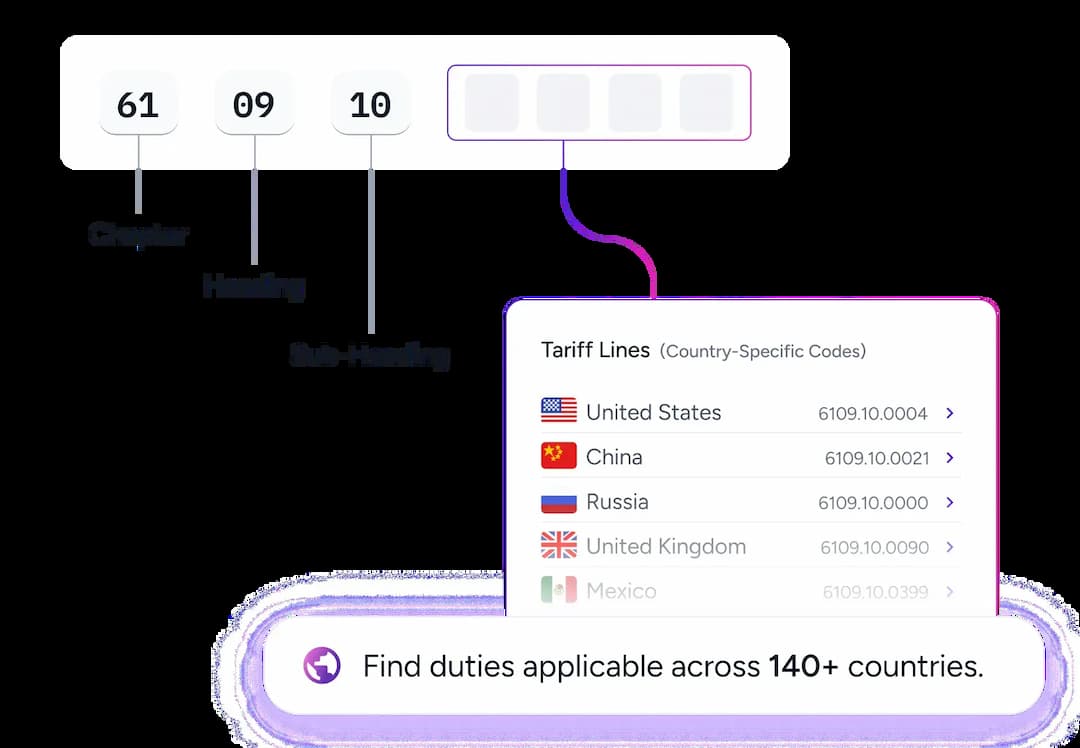
HS Code Lookup helps classify products under appropriate HS code and find duties applicable across 140+ countries. Find and discover HS classification, tariffs, taxes, controls, rulings, ECCNs, and default and preferential duties for HS code 9114.

WCO Notes for Heading 9114
91.14 ‑ Other clock or watch parts.
9114.30 ‑ Dials
9114.40 ‑ Plates and bridges
9114.90 ‑ Other
This heading covers all clock or watch parts other than :
(a) Parts excluded by Chapter Note 1 :
(1) Weights, clock or watch glasses, watch chains, ball bearings and bearing balls (e.g., for self‑winding watches).
(2) Parts of general use as defined in Note 2 to Section XV, e.g., screws (bridge, crown, dial, ratchet, click, end‑stone cap or index disc, yoke, setting lever, etc.), taper pins, clock chains, figures for dials, of base metal (Section XV) or similar goods of plastics (Chapter 39) or of precious metal or of metal clad with precious metal (generally heading 71.15).
These parts are classified in their own appropriate headings. However, clock and watch springs (mainsprings, hairsprings, etc.) remain in this heading.
(b) Parts specifically included in other headings of this Chapter (e.g., the complete and assembled movements of heading 91.08 or 91.09, the movement sets, incomplete watch or clock movements, assembled or rough watch or clock movements of heading 91.10, the cases of heading 91.11 or 91.12 and the watch straps, watch bands and watch bracelets of heading 91.13).
Except as provided in paragraph (a) or (b) above, parts suitable for use both in clocks or watches and in other articles, for example, in toys, meters or measuring or precision instruments (springs, trains, jewels, hands, etc.) fall in this heading (see Chapter Note 4). However, the heading does not cover parts which are not clearly clock or watch parts (e.g., printing or totalling devices for time‑registers, and certain other parts used in articles of heading 91.06 or 91.07).
The heading includes identifiable blanks of clock or watch parts, but it excludes metal pieces not yet recognisable as clock or watch parts (e.g., plates, bridges, etc., direct from the lathe or roughly cut to shape, without drilling, hollowing, etc.). These are classified according to their constituent material.
The clock or watch parts of this heading may be unpolished, polished, nickel‑plated, rhodium‑plated, silvered, gilded, varnished, etc., or jewelled.
Subject to the above provisions, the principal clock or watch parts classified here are :
(A) PARTS OF WATCH MOVEMENTS
(regardless of complexity of system)
These include :
(1) Frame : plate (and any additional plates), bridges (of the barrel, centre wheel, third wheel, fourth wheel, balance‑wheel (cock), escapement, setting wheel, etc.).
(2) Driving mechanism : mainspring, barrel, barrel cover, barrel arbor and ratchet, click, click spring.
(3) Train : centre wheel and pinion, third wheel and pinion, fourth wheel and pinion.
(4) Motion work : cannon pinion, minute wheel pinion and minute wheel, hour wheel.
(5) Escapement (anchor or lever, pin pallet, cylinder, detent, etc.) : escape wheel and pinions, lever, pallet staff, rollers, pallet stones, impulse pin, cylinder.
(6) Regulating device : balance, balance staff, hairspring (flat, Bréguet, cylindrical), tuning‑fork, stud, collet, regulator, index stud, end‑stone cap or index disc, regulator spring, lower cap jewel end‑piece, including special parts for shock‑proof devices.
(7) Winding and setting mechanism : crown, winding stem and pinion, clutch wheel, setting wheels, crown ratchet wheel, crown wheel core, yoke (rocking bar), setting lever, setting lever spring and yoke springs.
(8) Parts of electronic movements : circuits for watches comprising, for example, an insulating base carrying printed connections and other discrete components formed otherwise than by printing (for example, coils, capacitors, resistors, diodes and transistors), possibly together with an integrated circuit.
(9) Platform escapements consist of the plate, bridges, escapement, balance‑wheel and hairspring, and the regulator of a clock or watch movement, with or without train. They remain classified here whether assembled with the escapement regulated, or unassembled.
Assembled platform escapements may be intended for incorporation in a whole range of appliances using clock or watch movements (time‑registers, time switches, etc.), and sometimes also in small clocks or alarm clocks.
(B) PARTS OF CLOCK OR ALARM CLOCK MOVEMENTS
Many of the parts of these movements are similar in principle to parts of watch movements but are larger.
Parts peculiar to clock movements include weight drums, pendulums, including compensated pendulums (mercury, invar stem, etc.), crutches, verges, verge wheels, recoil escapements, dead‑beat (or Graham) escapements, etc., independent winding keys. Parts of alarm clock movements include fixed winding keys and knobs for setting.
(C) STRIKING WORK PARTS
(1) Striking work of alarm clocks : stop or detent, notched collar, release wheel, escape wheel, index staff, pallet, striking hammer, etc.
(2) Clock striking work (locking plate type, rack type, etc.) : drum or barrel and barrel wheel, locking plate, great wheel, pin wheel, third wheel, warning wheel, fly, detents, levers or fly springs, repeater rack, snail, hammer, lifting piece, arbor, fly wheel, gathering pallet, rack, ball, gong, chimes.
(D) JEWELS
This category includes only worked stones (jewels), i.e., those which have been turned, cut, polished, drilled, hollowed, etc., or mounted (in a setting or a screw). Unworked or roughly sawn jewels are excluded (Chapter 71). Watchmakers’ jewels are usually extremely small, their diameter and thickness rarely exceeding 2 mm and 0.5 mm, respectively.
The principal stones used in clock‑ or watch‑making are natural or synthetic rubies, sapphires and garnets, and occasionally diamonds. In cheap articles, glass is sometimes used, or the jewels are replaced by metal caps.
Clock or watch jewels bear the names of parts which they support, e.g., centre wheel jewels, third wheel jewels, fourth wheel jewels, escape wheel jewels, pallet staff jewels and balance‑wheel jewels. The bearing of a cylindrical pivot consists of a drilled jewel or of a drilled jewel and a solid jewel (end‑stone). There are also bearings consisting of conical cavity jewels.
In addition to round jewels used as bearings, clocks and watches with a lever escapement usually also contain three special jewels : two pallet stones (bevelled jewels attached to each end of the pallet) and an impulse pin (a jewel, usually of semi‑round or triangular section, intended for the roller).
The jewelling process may be carried out by hand setting, by using a mounted jewel, or, more usually, by pressing.
(E) DIALS
Dials generally bear divisions or figures indicating the hours, minutes and seconds. They may be flat or curved. They are usually of silvered, gilded, painted, oxidised or otherwise coated brass, of enamelled copper, of gold or silver, or sometimes of paper, glass, plastics or pottery. The figures and inscriptions are produced by various methods (transfer, painting, stamping, etc.). Dials may have luminous figures or symbols.
Dials are fixed to the plate (or to an additional plate, called “dial plate”) by screws, pins or an outer ring of metal.
(F) HANDS
These indicate hours, minutes and seconds. The heading also covers special hands for chronograph watches and hands for alarm clocks, etc. Watch or clock hands may be flat or curved, and may be made of steel, brass or copper, generally polished, oxidised, nickel‑plated, chromium‑plated, silvered, gilded or lacquered; they are sometimes of gold and even of bone. Luminous hands have “windows” filled with a compound based on radioactive salts (radio‑thorium, meso‑thorium, etc.). There are innumerable types of hands, designed to suit the type of dial.
______________________

What is HS code 9114?

How many sub-headings are there in HS code 9114?
International Trade Compliance Simplified