














HS Code Lookup for Heading 9606
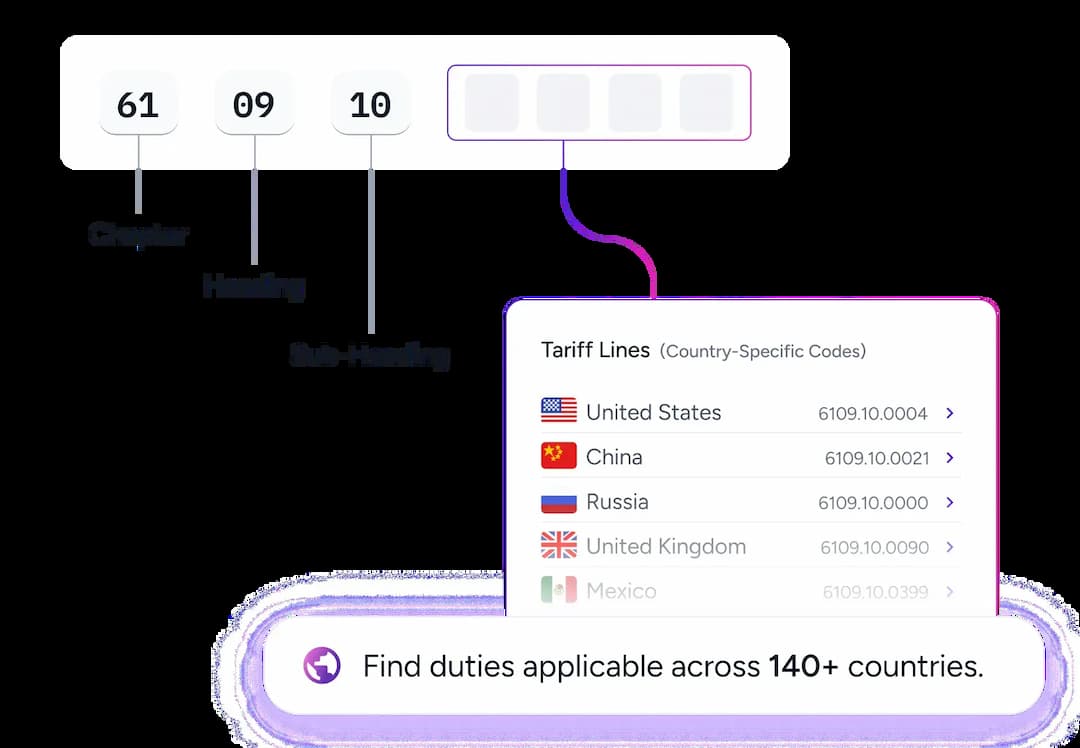
HS Code Lookup helps classify products under appropriate HS code and find duties applicable across 140+ countries. Find and discover HS classification, tariffs, taxes, controls, rulings, ECCNs, and default and preferential duties for HS code 9606.

WCO Notes for Heading 9606
96.06 ‑ Buttons, press‑fasteners, snap‑fasteners and press‑studs, button moulds and other parts of these articles; button blanks.
9606.10 ‑ Press‑fasteners, snap‑fasteners and press‑studs and parts therefor
‑ Buttons :
9606.21 ‑ ‑ Of plastics, not covered with textile material
9606.22 ‑ ‑ Of base metal, not covered with textile material
9606.29 ‑ ‑ Other
9606.30 ‑ Button moulds and other parts of buttons; button blanks
This heading covers buttons, studs, and similar articles used for fastening or decorating articles of apparel, household linen, etc. These articles may be made of various materials and they may contain natural or cultured pearls, precious or semi‑precious stones (natural, synthetic or reconstructed), precious metal or metal clad with precious metal provided these latter materials are present as minor components only. Otherwise they fall in Chapter 71.
The principal materials used for making buttons, studs, etc., are base metals, wood, corozo, dom, bone, horn, plastics, ceramics, glass, ebonite, compressed paperboard, leather, composition leather, ivory, tortoise‑shell or mother‑of‑pearl. They may also consist of combinations of these materials and may be textile covered.
The heading includes :
(A) Pierced and shank buttons. These may be of various sizes and shapes according to the purpose for which they are to be used (underwear, outer garments, footwear, etc.).
Spherical buttons may be distinguished from beads by the fact that the hole for the thread is not pierced centrally.
In some shank buttons, the shank is in the form of a spring‑type hinge which enables the button to be secured to a garment without sewing. Other types (e.g., “bachelor buttons”) are affixed to garments by a snap mechanism.
(B) Press‑fasteners, snap‑fasteners and press‑studs. These consist of two or more parts, and operate by means of a snap mechanism. Such fasteners and studs may be designed for sewing on garments, etc., or they may be attached by “riveting” (e.g., press‑studs for gloves).
Press‑fasteners and the like remain classified in this heading when the separate parts are supplied already mounted on strips of narrow tape.
The heading also covers :
(1) Button moulds. These articles are the interior part or “body” of certain types of buttons, and are designed to be covered with textile material, paper, leather, etc. They are classified here only when clearly recognisable as designed for button manufacture. These moulds may be of wood, orris root, etc., but the most usual type consists of two metal parts, one of which is covered with textile, etc., while the other fits into the first and holds the textile in place.
(2) Other parts of buttons, etc., identifiable as such (e.g., shanks, bases, heads).
(3) Button blanks. These include :
(i) Moulded blanks as obtained from the mould and not yet usable as buttons. They normally require to be trimmed, pierced and polished, but are readily distinguishable as being intended for manufacture into buttons.
(ii) Stamped metal blanks consisting of two parts (top and base) designed to fit one into the other.
(iii) Blanks of mother‑of‑pearl, corozo, wood, etc., worked (e.g., rounded or hollowed out on one or both sides or otherwise shaped, with rimmed edges, polished or pierced) so that they are clearly identifiable as intended for making buttons. On the other hand, a disc merely sawn, cut or polished, but not further worked, is not regarded as a button blank and is to be classified according to the constituent material.
The heading excludes cuff‑links (heading 71.13 or 71.17).

What is HS code 9606?

How many sub-headings are there in HS code 9606?
International Trade Compliance Simplified