














HS Code Lookup for Heading 9705
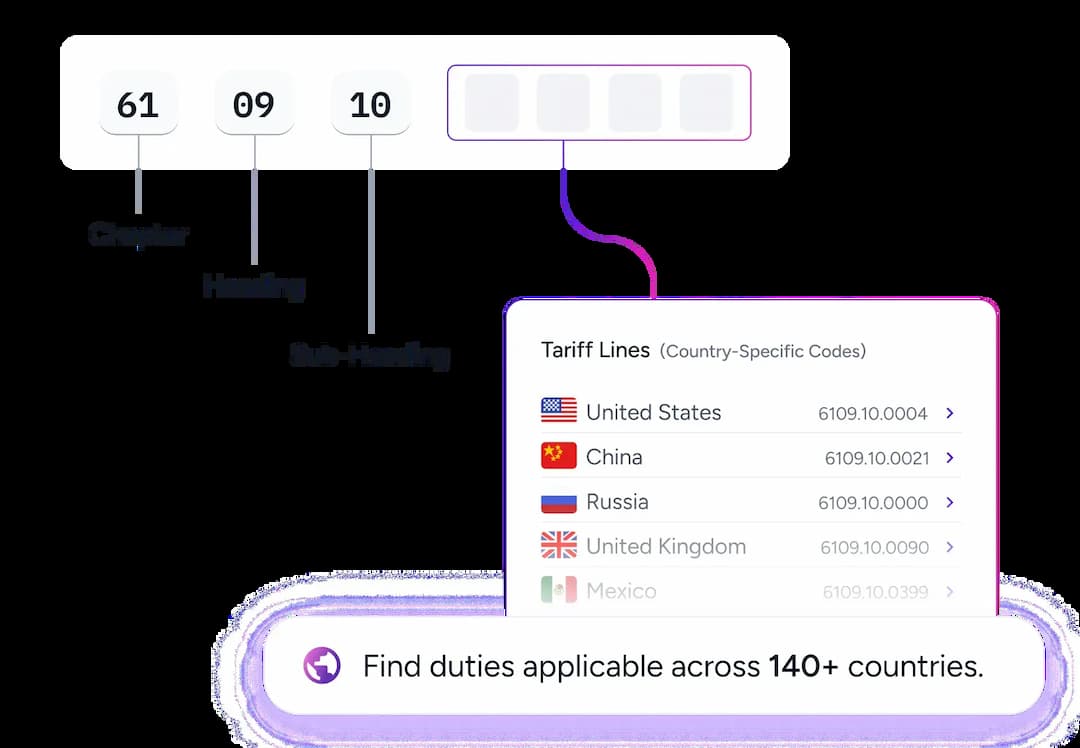
HS Code Lookup helps classify products under appropriate HS code and find duties applicable across 140+ countries. Find and discover HS classification, tariffs, taxes, controls, rulings, ECCNs, and default and preferential duties for HS code 9705.

WCO Notes for Heading 9705
97.05 ‑ Collections and collectors’ pieces of archaeological, ethnographic, historical, zoological, botanical, mineralogical, anatomical, paleontological or numismatic interest.
9705.10 ‑ Collections and collectors' pieces of archaeological, ethnographic or historical interest
‑ Collections and collectors' pieces of zoological, botanical, mineralogical, anatomical or paleontological interest :
9705.21 ‑ ‑ Human specimens and parts thereof
9705.22 ‑ ‑ Extinct or endangered species and parts thereof
9705.29 ‑ ‑ Other
‑ Collections and collectors' pieces of numismatic interest :
9705.31 ‑ ‑ Of an age exceeding 100 years
9705.39 ‑ ‑ Other
These articles are very often of little intrinsic value but derive their interest from their rarity, their grouping or their presentation. The heading includes :
(A) Collections and collectors’ pieces of archaeological, ethnographic or historical interest. Included are :
(1) Articles “of archaeological interest” provide scientific or humanistic understanding of past human behaviour, evidence of cultural adaption and artistic expression, they would normally be discovered as a result of excavation (e.g. scientific, clandestine or accidental) or exploration (i.e. on land or under water).
Such articles include, but are not limited to cave paintings, frescoes, ancient sculptures in the round and reliefs, petroglyphs and carved architectural elements such as column capitals, door lintels, etc.; necklaces, bracelets, finger rings, ear and nose ornaments, brooches, crowns, pins, pectorals, belts and lip plugs; inscribed clay tablets, inscribed shell or bone, stones with incised or raised signs, symbols and words and handwritten or illustrated texts on papyrus, wood, silk, parchment, paper or vellum.
(2) Articles “of ethnographic interest” are generally a product of an autochthonous, tribal or non-industrial society and are needed for the practice of traditional religions or are important to the cultural heritage of a people because they possess distinctive characteristics, are comparatively rare or contribute to the knowledge of the origins, development or history of that people.
Such articles include, but are not limited to, religious and ceremonial regalia and ancestral and religious figures and sculptures; relics and reliquaries, shrunken heads, scalps, decorated skulls, tools and musical instruments made from human bone; and handwritten documents or texts, sometimes with illustrations, on wood, silk, parchment, vellum, paper or leather. Documents may be found as individual sheets, scrolls or bound volumes. Examples include handwritten Bibles, Torahs, Korans and other religious texts, letters, treatises, doctrines and essays.
(3) Articles of “historical interest” are human-made, relate to significant national or global historical events of political, scientific, technological, military or social significance, or the life or achievements of leaders, thinkers, scientists and artists of national or global renown.
Such articles include, but are not limited to, a uniform or a weapon of a soldier in the Middle Ages, the royal insignia used in the coronation of a sovereign and a vessel used in an alchemy laboratory in ancient civilizations.
(B) Collections and collectors’ pieces of zoological, botanical, mineralogical, anatomical or paleontological interest. Included are :
(1) Dead animals of any species, preserved dry or in liquid; stuffed animals for collections.
(2) Blown or sucked eggs; insects in boxes, frames, etc. (other than mounted articles constituting imitation jewellery or trinkets); empty shells, other than those of a kind suitable for industrial use.
(3) Seeds or plants, dried or preserved in liquid; herbariums.
(4) Specimens of minerals (not being precious or semi‑precious stones falling in Chapter 71); specimens of petrification.
(5) Osteological specimens (skeletons, skulls, bones).
(6) Anatomical and pathological specimens.
(7) Articles “of paleontological interest” include, but are not limited to, the fossilized remains, traces or imprints of organisms, whether animal or vegetable, preserved in or on the earth's crust, which provide information about the history of non-human life on earth.
Such articles include, but are not limited to, fossils of dinosaurs, extinct plants and animals.
(C) Collections and collectors’ pieces of numismatic interest.
These are coins, banknotes which are no longer legal tender, other than those of heading 49.07, and medals presented as collections or as separate pieces; in the latter case, each consignment usually contains only a few examples of any one coin or medal, and these are classified here only if clearly intended for a collection.
The heading excludes coins and medals not regarded as collectors’ pieces nor forming a collection of numismatic interest (e.g., large consignments of any one coin or medal); these generally fall in Chapter 71, but any such “coins” and “medals” so battered or bent that they are fit only for remelting, etc. are prima facie classifiable in the headings for scrap and waste metal.
Coins which are legal tender in the country of issue fall in heading 71.18 even if they are put up for general sale in presentation cases.
Coins or medals mounted as jewellery are excluded (Chapter 71 or heading 97.06).
Banknotes which are no longer legal tender, and which are not regarded as collectors’ pieces nor as forming a collection, are classified in heading 49.07.
*
* *
Goods produced as a commercial undertaking to commemorate, celebrate, illustrate or depict an event or any other matter, whether or not production is limited in quantity or circulation, do not fall in this heading as collections or collectors’ pieces of historical or numismatic interest unless the goods themselves have subsequently attained that interest by reason of their age or rarity.

What is HS code 9705?

How many sub-headings are there in HS code 9705?
International Trade Compliance Simplified