

















Podcasts
Watch videos featuring supply chain experts






Introduction & The Macro Economic Paradox
The global commerce landscape has undergone significant structural changes. Historically, economic sanctions were used as blunt, secondary instruments alongside traditional military warfare to isolate certain geographical enemy governments. Between 1945 and 1990, the UN Security Council enacted just two comprehensive sanctions regimes. However, following the terrible humanitarian and economic consequences of the 1990s Iraqi embargo, a significant paradigm change occurred. Broad national bans have been essentially supplanted by hyper targeted, list-based regulations directed at specific individuals, business entities, shell companies, and boats.
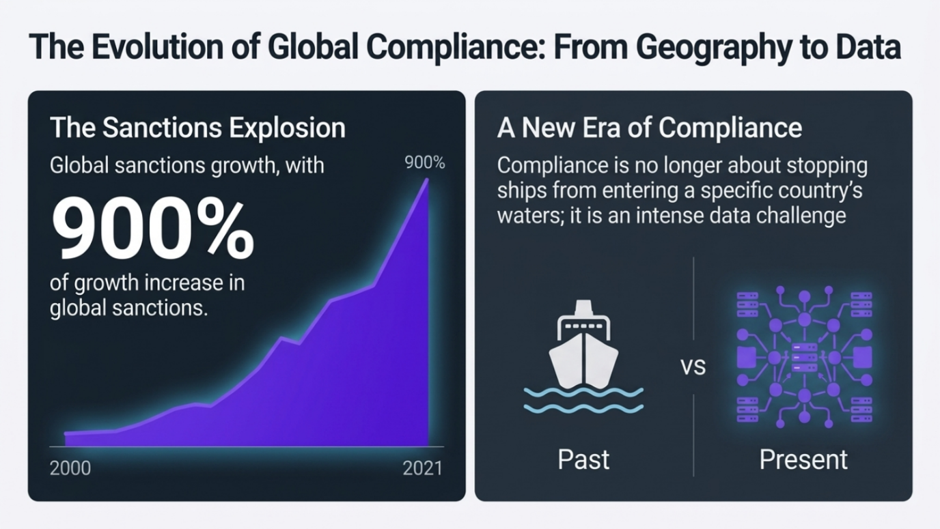
Today compliance is just not about going through list and cross validating it, it has become more pragmatic and have developed layers of supervision. The evolution of compliance from 2000 to 2021 which have shifted from embargo (complete ban on trade with a country) to multiple sanctions. Between 2000 and 2021, global sanctions deployment increased by a staggering 900%. Compliance is no longer about preventing ships from accessing a given country's waters; rather, it is a data intensive task. Regulators such as the US Office of Foreign Assets Control (OFAC) now maintain an active Specially Designated Nationals (SDN) list that includes well over 1700+ distinct entries from dozens of decentralised and dynamic regimes.
The Fallacy of Flat Watchlists & The Strict Liability Trap
Legacy trade compliance solutions rely on an inherently flawed paradigm the notion of "master list" aggregation. Many screening systems merely collect various government watchlists and store them in a flat digital database. However, as Peter L. Fitzgerald describes in his paper, worldwide watchlists are fundamentally inconsistent, unstandardised, and plagued by significant data ambiguity. A problem causing delays in operations is the issue with matching identities. Watchlists often do not have unique information resulting in too many false matches that stop legitimate trades from happening. For instance, vague or common names like adding "Global" to a list of sanctions, against Yugoslavia make compliance teams manually check thousands of harmless transactions. This data mess gets even worse with names written in scripts.
The name محمد can be written in ways like Muhammad or Mohammed and this lets targeted people avoid being caught by simple name checks. This makes it hard for compliance teams to do their job and for businesses to operate smoothly. The issue of identity matching needs to be fixed to prevent these problems. Watchlists need to be more accurate to avoid matches and ensure that legitimate trades can happen without delays.
This structural fragmentation becomes catastrophic when weaponized by a zero-tolerance strict liability standard. Regulators do not need to prove fraudulent intent or gross negligence, the mere execution of a prohibited transaction triggers immediate liability. For complex multinational enterprises, automated large value transfer systems often strip out critical customer identification until the final payment stage, effectively blinding clearing branches.
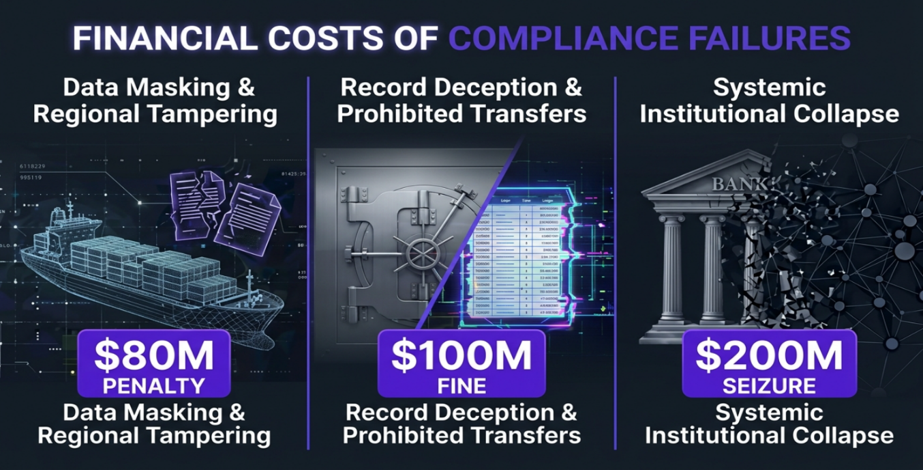
Historical enforcement data underscores the severe financial penalties levied against foreign institutions caught in these structural data traps:
The Economics of the Operational Blind Spot
Treating compliance just as a legal cost is a mistake. It does not take into account the picture. Companies that do not track their cargo in time are losing money every day. This is because they do not know what is going on with their shipments. Research on companies with supply chains all over the world shows that the way they do business inside their companies is very costly. This includes things, like finding suppliers making sure they follow rules and managing their inventory. These things make up 40% of the total cost of importing and exporting goods. The other 60% of the cost is decided by companies that provide logistics services to help get the goods from one place to another.
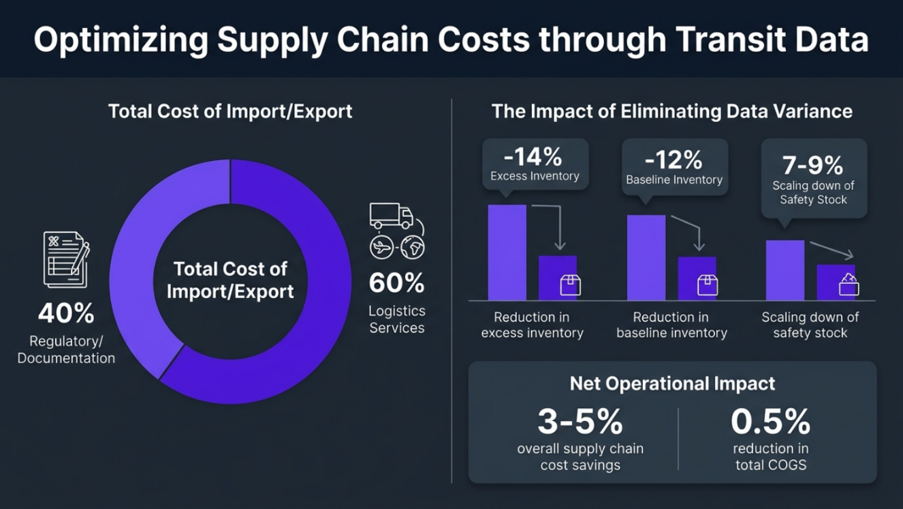
Integrating Container Monitoring Devices (CMDs) into the core screening framework fundamentally rewrites this capital equation. Lowering the statistical variance of transit data drives a 14% reduction in excess inventory, a 12% planned reduction in baseline inventory, and scales down safety stock holding costs by 7% to 9%. Ultimately, eliminating this operational blind spot yields a 3% to 5% cost savings on supply chain operations, directly reducing the final unit Cost of Goods Sold (COGS) by an average of 0.5% without compromising material, manufacturing, or marketing budgets.
Marrying Real Time Risk Isolation with Physical Telemetry
International trade finance needs a specialized system to balance two important things: following all the rules perfectly and making cross-border trade happen quickly. Fashioned screening processes get stuck when they have to follow strict rules that match text exactly and this is a problem across all levels of operation. The immense friction from these legacy checkpoints is kind a starkly illuminated by the field data gathered during the SMART-CM project (funded under the European Union's Seventh Framework Programme). In the project’s operational demonstrators, there was this clear exposure of a massive structural bottleneck in global maritime routes: while a container spends only 12.83 hours of dwell time at departure ports, its processing time basically skyrockets to an average of 60.54 hours at arrival ports, a staggering fivefold gap driven by uncoordinated port operations and redundant customs inspections.
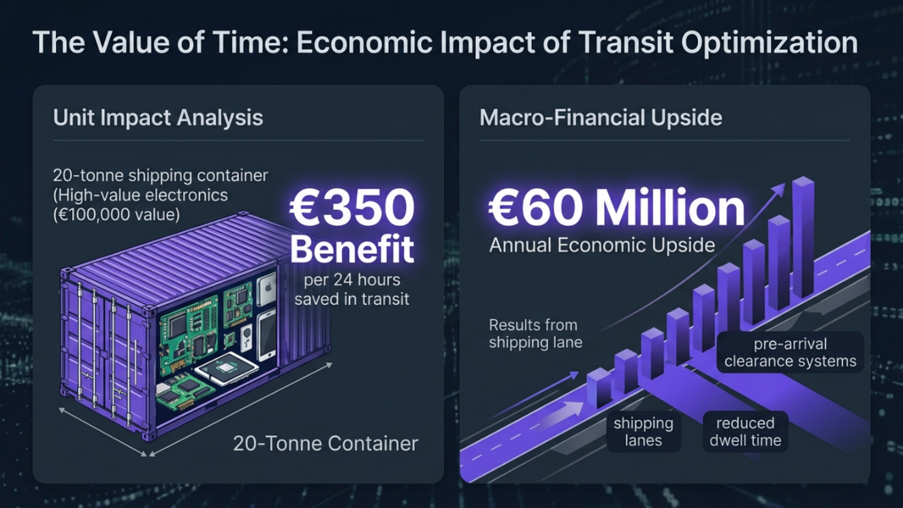
If we apply the economic concept of Value of Time, VOT, then the macro-financial cost of this delay becomes much more obvious, somehow. For the usual 20-tonne container carrying time-sensitive cargo (like machinery electronics, or transport equipment), with a declared value around €100,000, the VOT multiplier means that cutting just one day off the transit phase creates a direct economic benefit of about €350. When you stretch that logic across major shipping lanes, putting in a dependable pre arrival clearance system to squeeze the arrival dwell time, gives an initial economic upside of roughly €60 million every year.
To capture this trapped capital a modern trade architecture must sort of drift away from the static, text-reliant systems of the past. High-value data infrastructure should instead ride on an inline Real-Time API Screening engine, together with a specialized, dynamic Multi-Jurisdictional Compliance Grid. Instead of handling sanctions like some flat single master list, the compliance engine needs to slice the checks based on the exact legal frameworks that steer each stage of a trade transaction, meaning overlapping filters run for U.S. OFAC, the European Union, the United Nations, and also local border authorities. That way the high-liability, transactional checkpoints like issuing a Letter of Credit, onboarding fresh global suppliers, or locking in trade finance contracts get processed right away, so clearing institutions can stay insulated from catastrophic strict liability traps.
How Trademo Solves This Problem?
Trademo’s Trade Screen, acts like a kind of smart dynamic layer that replaces those static, single-source watchlists with a multi-jurisdictional compliance grid. The platform automatically sorts and carries out overlapping compliance checks based on the specific legal frameworks like U.S. OFAC, EU, and UN rules, that control each separate leg, of a cross-border transaction. And instead of waiting later, it validates data and document integrity right at the regional point of origin, so it helps neutralize downstream data tampering, and lets international trade keep going seamlessly, even inside strict liability environments.
Crucially, the platform drives this integrity from the ground up by digitizing core trade documents such as the Bill of Lading, Commercial Invoice, and Letter of Credit transforming vulnerable paper trails into secure, auditable digital assets. By linking this digitized documentation directly to real-time vessel telemetry and automated risk scoring, Trademo empowers compliance and logistics teams to manage by exception and proactively secure the entire trade life-cycle.