














HS Code Lookup for Chapter 55
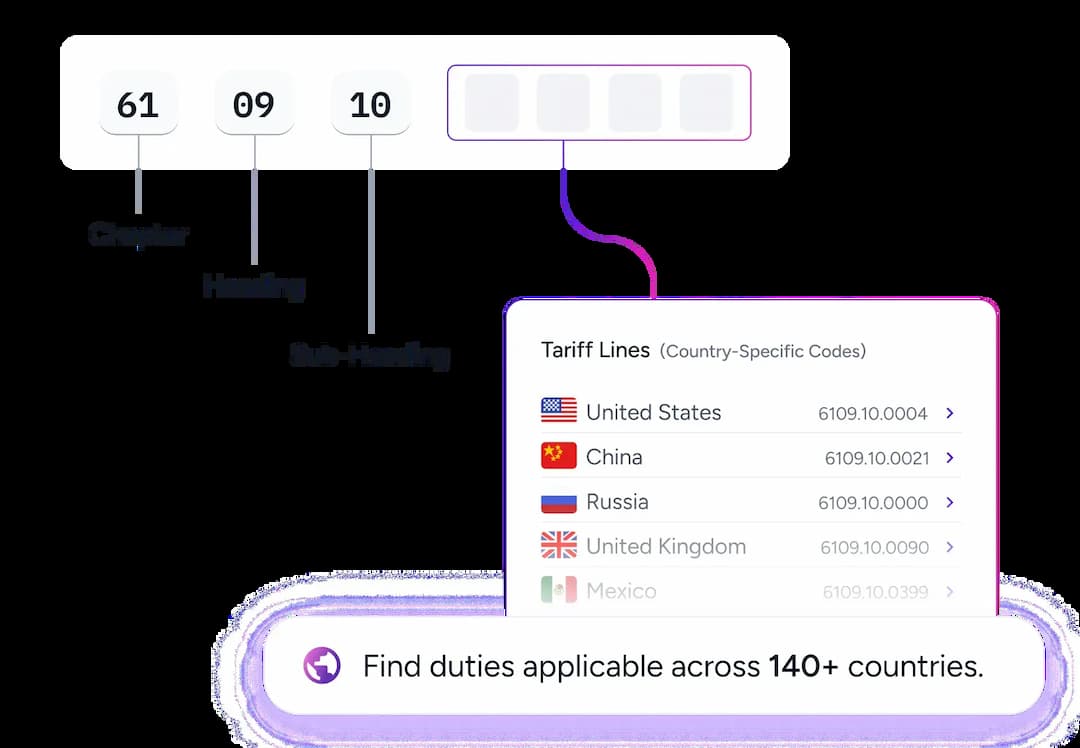
HS Code Lookup helps classify products under appropriate HS code and find duties applicable across 140+ countries. Find and discover HS classification, tariffs, taxes, controls, rulings, ECCNs, and default and preferential duties for HS code 55.

WCO Notes for Chapter 55
Chapter 55
Man‑made staple fibres
Note.
1.‑ Headings 55.01 and 55.02 apply only to man‑made filament tow, consisting of parallel filaments of a uniform length equal to the length of the tow, meeting the following specifications :
(a) Length of tow exceeding 2 m;
(b) Twist less than 5 turns per metre;
(c) Measuring per filament less than 67 decitex;
(d) Synthetic filament tow only : the tow must be drawn, that is to say, be incapable of being stretched by more than 100 % of its length;
(e) Total measurement of tow more than 20,000 decitex.
Tow of a length not exceeding 2 m is to be classified in heading 55.03 or 55.04.
GENERAL
The General Explanatory Note to Section XI should be taken into account in reading the Explanatory Notes to this Chapter.
The Chapter covers the man‑made fibres described in the General Explanatory Note to Chapter 54 when in the form of staple fibres (i.e., discontinuous fibres) or of certain filament tow; it also covers the products arising at the various stages of working these fibres or tow, up to and including yarn and woven fabrics. It further includes mixed textile products classified as products of man‑made staple fibres by application of Note 2 to Section XI.
Man‑made staple fibres are usually manufactured by extrusion through spinnerets (jets) having a large number of holes (sometimes several thousand); the filaments from a large number of spinnerets (jets) are then collected together in the form of a tow. This tow may be stretched and then cut into short lengths, either immediately or after having undergone various processes (washing, bleaching, dyeing, etc.) while in the tow form. The length into which the fibres are cut is usually between 25 mm and 180 mm and varies according to the particular man‑made fibre concerned, the type of yarn to be manufactured and the nature of any other textile fibres with which they are to be mixed.
Waste (including noils, yarn waste and garnetted stock) of man‑made filaments or staple fibres is also included in this Chapter.
This Chapter does not include :
(a) Textile fibres, not exceeding 5 mm in length (flock), of heading 56.01.
(b) Asbestos of heading 25.24 and articles of asbestos and other products of heading 68.12 or 68.13.
(c) Carbon fibres and articles of carbon fibres, of heading 68.15.
(d) Glass fibres and articles of glass fibres, of heading 70.19.

What is HS code 55?

How many headings are there in HS code 55?
International Trade Compliance Simplified