















HS Code Lookup for Heading 5501
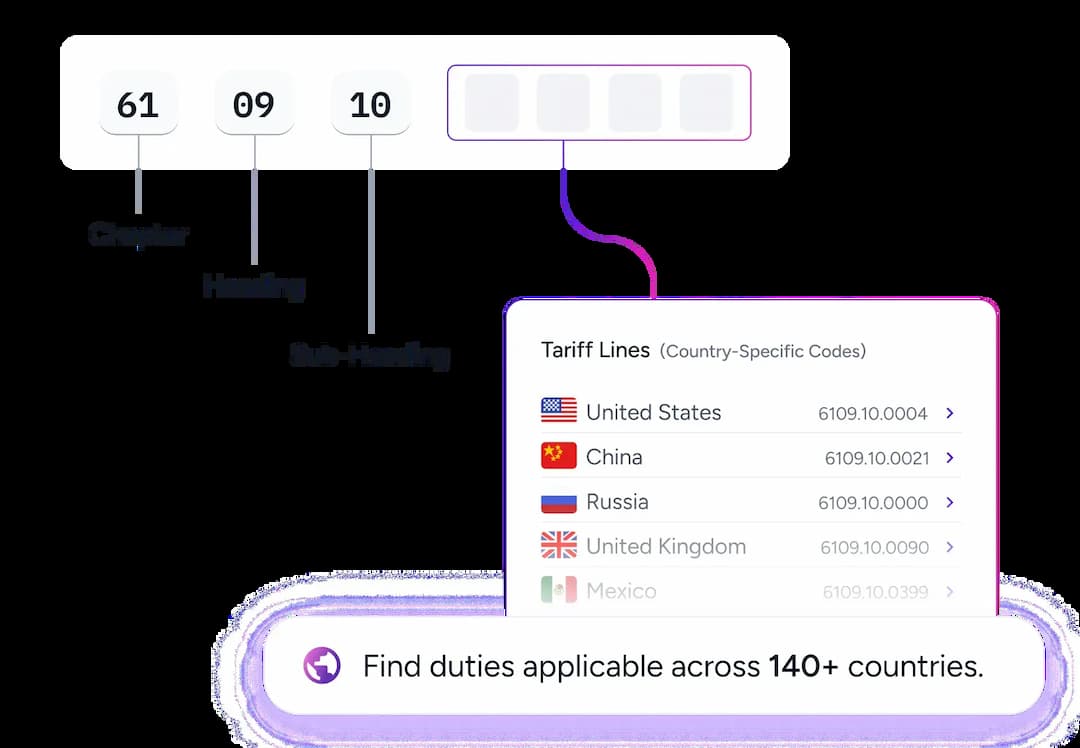
HS Code Lookup helps classify products under appropriate HS code and find duties applicable across 140+ countries. Find and discover HS classification, tariffs, taxes, controls, rulings, ECCNs, and default and preferential duties for HS code 5501.

WCO Notes for Heading 5501
55.01 ‑ Synthetic filament tow.
‑ Of nylon or other polyamides :
5501.11 - ‑ Of aramids
5501.19 - ‑ Other
5501.20 ‑ Of polyesters
5501.30 ‑ Acrylic or modacrylic
5501.40 - Of polypropylene
5501.90 ‑ Other
This heading covers synthetic filament tow produced as described in the General Explanatory Note to this Chapter, only if it meets the following specifications (see also Chapter Note 1) :
(A) The tow must exceed 2 m in length.
(B) The tow must be untwisted or be twisted less than 5 turns per metre.
(C) Each filament must measure less than 67 decitex.
(D) The tow must have been drawn, i.e., it must be incapable of being stretched by more than 100 % of its length.
(E) The total measurement of the tow must exceed 20,000 decitex.
The requirement under paragraph (D) is designed to ensure that the tow is in a state ready for conversion into staple fibres. After extrusion synthetic filaments are insufficiently oriented and must be drawn in order to effect orientation of their molecules and give them their required properties. Drawn tow still retains a certain elasticity but normally breaks on being stretched by considerably less than 100 % of its length. On the other hand, undrawn tow can be stretched to between three and four times its length before it breaks.
Tow of this heading is generally used for the manufacture of yarn of synthetic staple fibres either by being :
(1) Cut into staple fibres and then converted into slivers, rovings and yarn by processes generally similar to those used for cotton or wool; or
(2) Converted into tops by the “tow‑to‑top” process (see Explanatory Note to heading 55.06) and subsequently into yarns.
The heading does not cover :
(a) Assemblies of synthetic filaments satisfying conditions (A), (B) and (C) above of a total measurement not exceeding 20,000 decitex or whatever the total measurement in the case of undrawn filaments (heading 54.02).
(b) Assemblies of synthetic filaments (each filament measuring 67 decitex or more) untwisted or twisted less than 5 turns per metre, whether or not drawn and whatever the total measurement (heading 54.04 if no cross‑sectional dimension of the individual filaments exceeds 1 mm or Chapter 39 otherwise).
(c) Synthetic filament tow satisfying conditions (B) and (C) above, but of a length not exceeding 2 m, whether or not drawn and whatever the total measurement (heading 55.03).

What is HS code 5501?

How many sub-headings are there in HS code 5501?
International Trade Compliance Simplified