














HS Code Lookup for Chapter 56
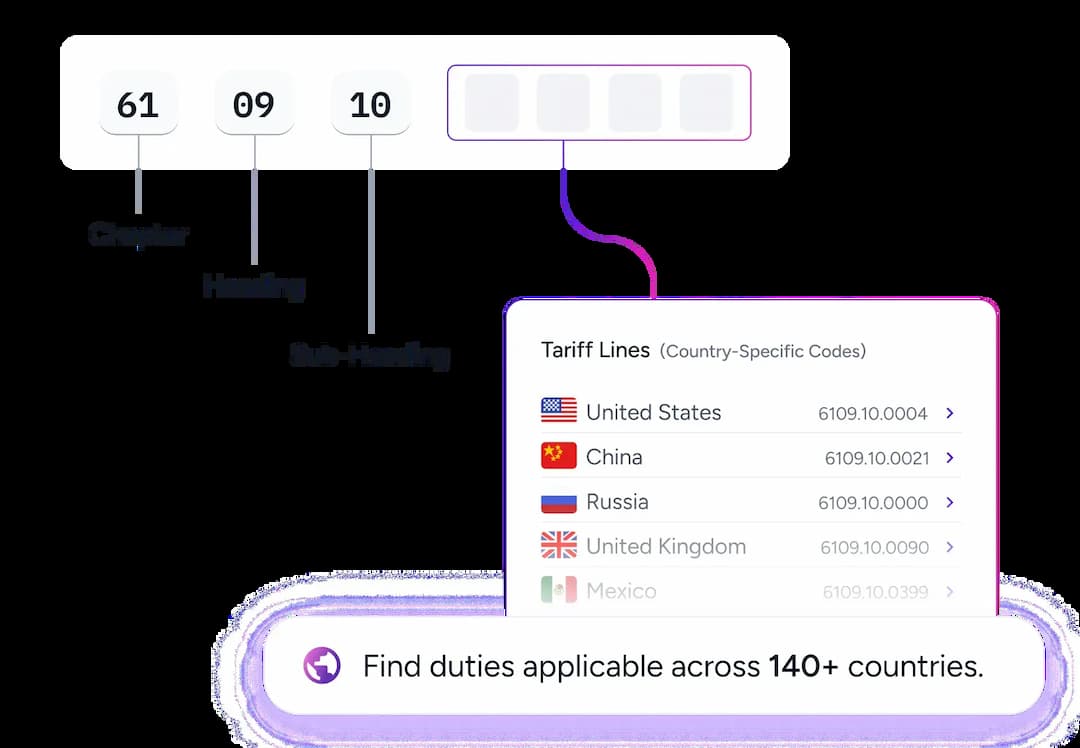
HS Code Lookup helps classify products under appropriate HS code and find duties applicable across 140+ countries. Find and discover HS classification, tariffs, taxes, controls, rulings, ECCNs, and default and preferential duties for HS code 56.

WCO Notes for Chapter 56
Chapter 56
Wadding, felt and nonwovens; special yarns;
twine, cordage, ropes and cables and articles thereof
Notes.
1.‑ This Chapter does not cover :
(a) Wadding, felt or nonwovens, impregnated, coated or covered with substances or preparations (for example, perfumes or cosmetics of Chapter 33, soaps or detergents of heading 34.01, polishes, creams or similar preparations of heading 34.05, fabric softeners of heading 38.09) where the textile material is present merely as a carrying medium;
(b) Textile products of heading 58.11;
(c) Natural or artificial abrasive powder or grain, on a backing of felt or nonwovens (heading 68.05);
(d) Agglomerated or reconstituted mica, on a backing of felt or nonwovens (heading 68.14);
(e) Metal foil on a backing of felt or nonwovens (generally Section XIV or XV); or
(f) Sanitary towels (pads) and tampons, napkins (diapers) and napkin liners and similar articles of heading 96.19.
2.‑ The term “felt” includes needleloom felt and fabrics consisting of a web of textile fibres the cohesion of which has been enhanced by a stitch‑bonding process using fibres from the web itself.
3.‑ Headings 56.02 and 56.03 cover respectively felt and nonwovens, impregnated, coated, covered or laminated with plastics or rubber whatever the nature of these materials (compact or cellular).
Heading 56.03 also includes nonwovens in which plastics or rubber forms the bonding substance.
Headings 56.02 and 56.03 do not, however, cover :
(a) Felt impregnated, coated, covered or laminated with plastics or rubber, containing 50 % or less by weight of textile material or felt completely embedded in plastics or rubber (Chapter 39 or 40);
(b) Nonwovens, either completely embedded in plastics or rubber, or entirely coated or covered on both sides with such materials, provided that such coating or covering can be seen with the naked eye with no account being taken of any resulting change of colour (Chapter 39 or 40); or
(c) Plates, sheets or strip of cellular plastics or cellular rubber combined with felt or nonwovens, where the textile material is present merely for reinforcing purposes (Chapter 39 or 40).
4.‑ Heading 56.04 does not cover textile yarn, or strip or the like of heading 54.04 or 54.05, in which the impregnation, coating or covering cannot be seen with the naked eye (usually Chapters 50 to 55); for the purpose of this provision, no account should be taken of any resulting change of colour.
GENERAL
This Chapter covers a number of textile products of a special character, e.g., wadding, felt, nonwovens, special yarns, cordage and certain articles of these materials.

What is HS code 56?

How many headings are there in HS code 56?
International Trade Compliance Simplified