















HS Code Lookup for Heading 5603
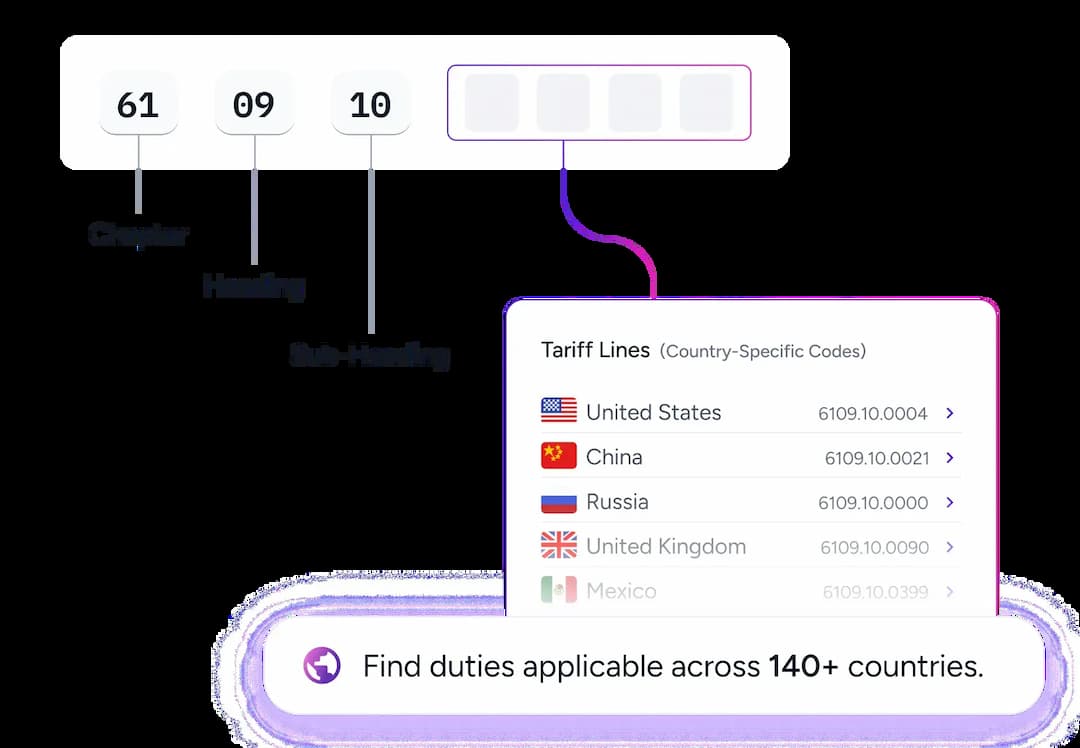
HS Code Lookup helps classify products under appropriate HS code and find duties applicable across 140+ countries. Find and discover HS classification, tariffs, taxes, controls, rulings, ECCNs, and default and preferential duties for HS code 5603.

WCO Notes for Heading 5603
56.03 ‑ Nonwovens, whether or not impregnated, coated, covered or laminated.
- Of man-made filaments :
5603.11 ‑ ‑ Weighing not more than 25 g/m2
5603.12 ‑ ‑ Weighing more than 25 g/m2but not more than 70 g/m2
5603.13 ‑ ‑ Weighing more than 70 g/m2 but not more than 150 g/m2
5603.14 ‑ ‑ Weighing more than 150 g/m2
- Other :
5603.91 ‑ ‑ Weighing not more than 25 g/m2
5603.92 ‑ ‑ Weighing more than 25 g/m2but not more than 70 g/m2
5603.93 ‑ ‑ Weighing more than 70 g/m2but not more than 150 g/m2
5603.94 ‑ ‑ Weighing more than 150 g/m2
A nonwoven is a sheet or web of predominantly textile fibres oriented directionally or randomly and bonded. These fibres may be of natural or man‑made origin. They may be staple fibres (natural or man‑made) or man‑made filaments or be formed in situ.
Nonwovens can be produced in various ways and production can be conveniently divided into the three stages : web formation, bonding and finishing.
I. Web formation
Four basic methods exist :
(a) by carding or air‑laying fibres in order to form a sheet. These fibres may be parallel, cross or random oriented (dry‑laid process);
(b) by extruding filaments which are directionally oriented, cooled and laid down directly into a web or which are coagulated, washed and laid down directly into a web in a wet form of the process (spun laid process);
(c) by suspending and dispersing fibres in water, depositing the resultant slurry onto a wire screen and forming a web by removal of the water (wet‑laid process);
(d) by various specialised technologies in which fibre production, web formation and usually bonding occur simultaneously (in situ process).
II. Bonding
After web formation the fibres are assembled throughout the thickness and width of the web (continuous method) or in spots or patches (intermittent method).
This bonding can be divided into three types :
(a) Chemical bonding, in which the fibres are assembled by means of a bonding substance. This may be done by impregnation with an adhesive binder such as rubber, gum, starch, glue or plastics, in solution or emulsion, by heat treatment with plastics in powder form, by solvents, etc. Binding fibres can also be used for chemical bonding.
(b) Thermal bonding, in which the fibres are assembled by submitting them to a heat (or ultrasonic) treatment, passing the web through ovens or between heated rollers (area bonding) or through heated embossing calenders (point bonding). Binding fibres can also be used for thermal bonding.
(c) Mechanical bonding, in which webs are strengthened by the physical entanglement of the constituent fibres. This may be achieved by means of high pressure air or water jets. It may also be achieved by needling but not by stitch‑bonding. However, needled products regarded as nonwovens are restricted to :
‑ filament‑based webs;
‑ staple fibre webs where the needling is complementary to other types of bonding.
These various bonding processes may also frequently be combined.
III. Finishing
Nonwovens may be dyed, printed, impregnated, coated, covered or laminated. Those covered on one or both surfaces (by gumming, sewing or by any other process) with textile fabric or with sheets of any other material are classified in this heading only if they derive their essential character from the nonwoven.
The heading includes, inter alia, adhesive tape consisting of a nonwoven coated with an adhesive of rubber, of plastics or of a mixture of these materials.
The heading also covers certain “roofing felts” in which the textile fibres are agglomerated with tar or similar substances, and certain products known as “bitumen felts” obtained in the same way but incorporating a small quantity of cork fragments.
However, the heading does not cover the following products which fall in Chapter 39 or 40 :
(a) Nonwovens, either completely embedded in plastics or rubber, or entirely coated or covered on both sides with such materials, provided that such coating or covering can be seen with the naked eye with no account being taken of any resulting change of colour.
(b) Plates, sheets or strip of cellular plastics or cellular rubber combined with nonwovens, where the textile material is present merely for reinforcing purposes (see the General Explanatory Note to Chapter 39, part entitled “Plastics and textile combinations”, and Item (A) of the Explanatory Note to heading 40.08).
*
* *
Nonwovens differ in thickness and in their characteristic features (flexibility, elasticity, resistance to tearing, absorbency, stability, etc.) according to the manufacturing or bonding process, the density of the fibres or filaments and the number of webs. Some nonwovens resemble paper, paperboard, cellulose wadding, chamois leather, or wadding of heading 56.01. They can be distinguished from paper, paperboard or cellulose wadding by the fact that the textile fibres are not digested during the process of manufacture.
Finally, the fact that the textile fibres or filaments are bonded throughout the thickness, and generally throughout the width, of the web or sheet also helps to distinguish these fabrics from certain types of wadding of heading 56.01 (see the Explanatory Note to that heading).
Certain nonwovens can be washed or wrung like other textile fabrics.
Except where they are covered more specifically by other headings in the Nomenclature, the heading covers nonwovens in the piece, cut to length or simply cut to rectangular (including square) shape from larger pieces without other working, whether or not presented folded or put up in packings (e.g., for retail sale). These include : facing webs (overlay) for incorporation in laminated plastics; top‑sheets for the manufacture of disposable napkins (diapers) or sanitary towels; fabrics for the manufacture of protective clothing or garment linings; sheets for filtering liquids or air, for use as stuffing materials, for sound insulation, for filtration or separation in road building or other civil engineering works; substrates for manufacturing bituminous roofing fabrics; primary or secondary backing for tufted carpets, etc.; handkerchiefs, bed linen, table linen, etc.
The heading also excludes :
(a) Bandages, medicated or put up for retail sale (heading 30.05).
(b) Nonwovens, impregnated, coated or covered with substances or preparations (e.g., perfumes or cosmetics (Chapter 33), soaps or detergents (heading 34.01), polishes, creams or similar preparations (heading 34.05), fabric softeners (heading 38.09)) where the textile material is present merely as a carrying medium.
(c) Needleloom felts (heading 56.02).
(d) Carpets and other floor coverings of nonwovens of Chapter 57.
(e) Tufted nonwovens of heading 58.02.
(f) Bolducs (heading 58.06).
(g) Embroidered nonwovens in the piece, in strips or in motifs (heading 58.10).
(h) Quilted textile products in the piece, composed of one or more layers of textile materials assembled by stitching or otherwise with padding material of nonwovens, other than embroidery of heading 58.10 (heading 58.11).
(ij) Nonwovens for technical uses, of heading 59.11.
(k) Nonwovens covered with abrasive powder or grain (heading 68.05) or with agglomerated or reconstituted mica (heading 68.14).
(l) Metal foil on a backing of nonwovens (generally Section XIV or XV).

What is HS code 5603?

How many sub-headings are there in HS code 5603?
International Trade Compliance Simplified