














HS Code Lookup for Chapter 58
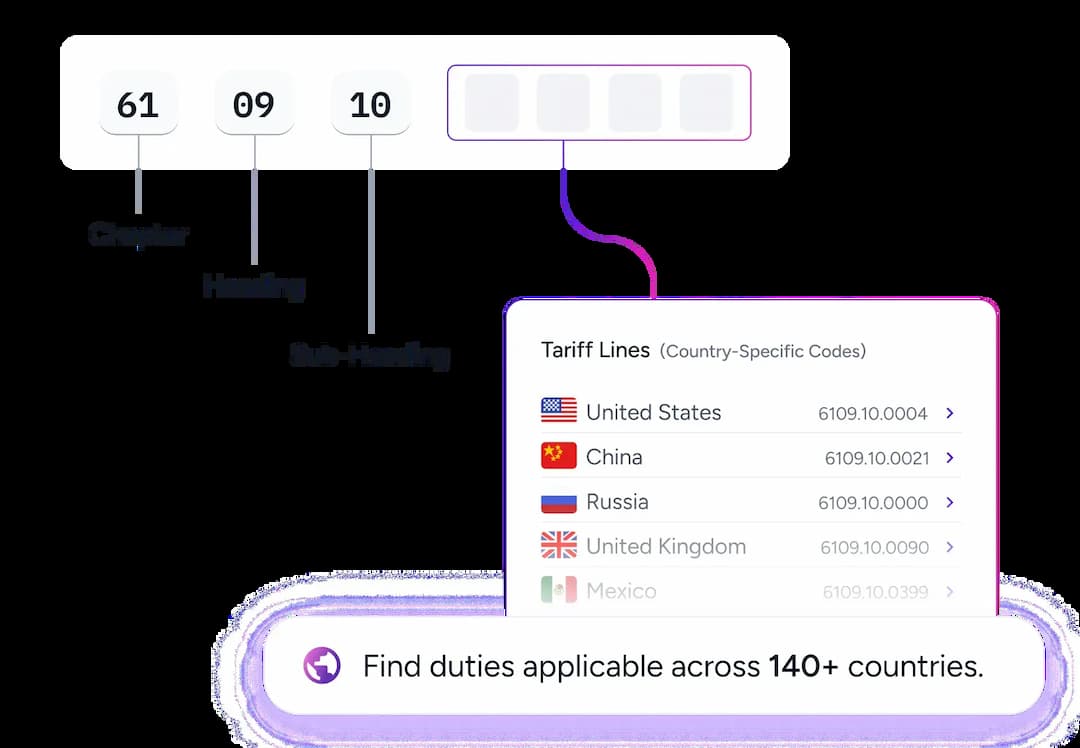
HS Code Lookup helps classify products under appropriate HS code and find duties applicable across 140+ countries. Find and discover HS classification, tariffs, taxes, controls, rulings, ECCNs, and default and preferential duties for HS code 58.

WCO Notes for Chapter 58
Chapter 58
Special woven fabrics; tufted textile fabrics;
lace; tapestries; trimmings; embroidery
Notes.
1.‑ This Chapter does not apply to textile fabrics referred to in Note 1 to Chapter 59, impregnated, coated, covered or laminated, or to other goods of Chapter 59.
2.‑ Heading 58.01 also includes woven weft pile fabrics which have not yet had the floats cut, at which stage they have no pile standing up.
3.‑ For the purposes of heading 58.03, “gauze” means a fabric with a warp composed wholly or in part of standing or ground threads and crossing or doup threads which cross the standing or ground threads making a half turn, a complete turn or more to form loops through which weft threads pass.
4.‑ Heading 58.04 does not apply to knotted net fabrics of twine, cordage or rope, of heading 56.08.
5.‑ For the purposes of heading 58.06, the expression “narrow woven fabrics” means :
(a) Woven fabrics of a width not exceeding 30 cm, whether woven as such or cut from wider pieces, provided with selvedges (woven, gummed or otherwise made) on both edges;
(b) Tubular woven fabrics of a flattened width not exceeding 30 cm; and
(c) Bias binding with folded edges, of a width when unfolded not exceeding 30 cm.
Narrow woven fabrics with woven fringes are to be classified in heading 58.08.
6.‑ In heading 58.10, the expression “embroidery” means, inter alia, embroidery with metal or glass thread on a visible ground of textile fabric, and sewn appliqué work of sequins, beads or ornamental motifs of textile or other materials. The heading does not apply to needlework tapestry (heading 58.05).
7.‑ In addition to the products of heading 58.09, this Chapter also includes articles made of metal thread and of a kind used in apparel, as furnishing fabrics or for similar purposes.
GENERAL
Except for heading 58.09, this Chapter covers a wide variety of textile products whose classification at heading level is independent of their constituent textile materials. Some of these products fall in this Chapter only if they are not “made up” in the sense of Part (II) of the General Explanatory Note to Section XI, but others are included whether or not made up.
It should be noted that, subject to the Notes of Chapter 59, gauze of heading 58.03, narrow woven fabrics of heading 58.06 and braids and ornamental trimmings in the piece of heading 58.08, impregnated, coated, covered or laminated, are excluded from Chapter 58 (usually Chapter 39, 40 or 59), whereas the other articles of this Chapter which have undergone the same treatments remain classified here, provided they have not thereby assumed the character of products of Chapter 39 or 40.

What is HS code 58?

How many headings are there in HS code 58?
International Trade Compliance Simplified