















HS Code Lookup for Heading 7317
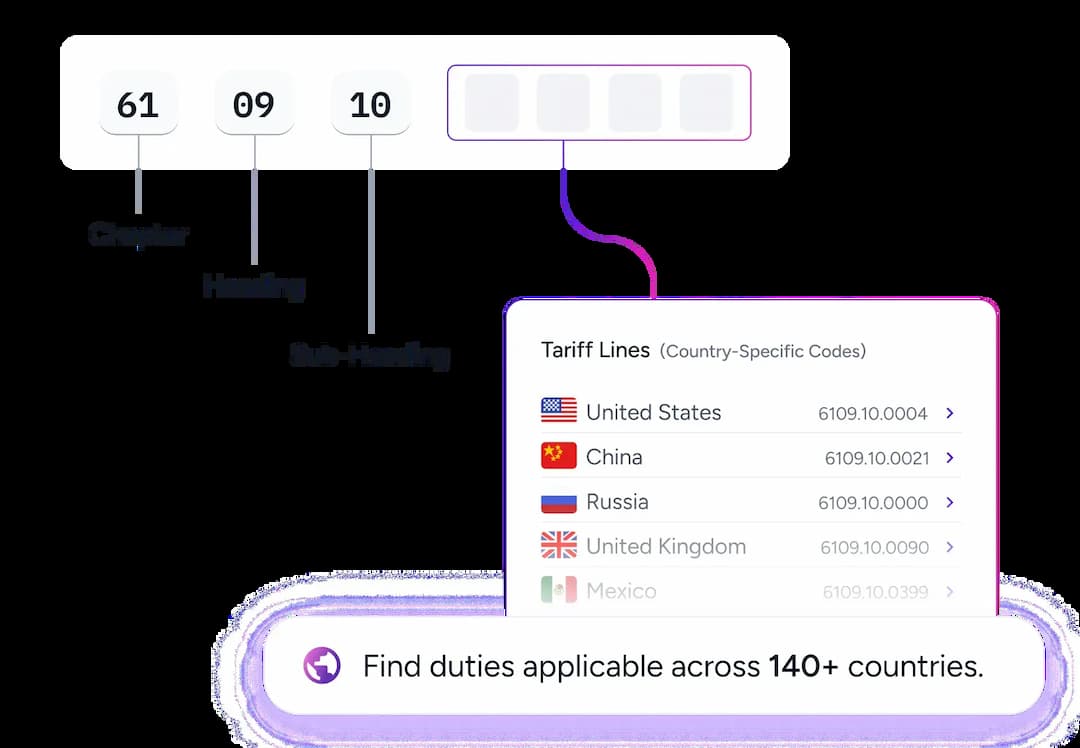
HS Code Lookup helps classify products under appropriate HS code and find duties applicable across 140+ countries. Find and discover HS classification, tariffs, taxes, controls, rulings, ECCNs, and default and preferential duties for HS code 7317.

WCO Notes for Heading 7317
73.17 ‑ Nails, tacks, drawing pins, corrugated nails, staples (other than those of heading 83.05) and similar articles, of iron or steel, whether or not with heads of other material, but excluding such articles with heads of copper.
The heading covers :
(A) Nails, tacks, staples (other than those of heading 83.05) and similar articles, usually manufactured by the following methods :
(1) Cold pressing from wire of the required thickness. Such wire nails usually have flat or rounded heads, though some are headless and pointed at one or both ends. Tapered shank nails and tacks are made in the same way except that they are sheared obliquely.
(2) Forging (by hand or machine) from an iron shank of the required thickness which is hammered to a point, after which the head is stamped out by a nail‑making machine.
(3) Cutting from sheet or strip followed, if necessary, by finishing either mechanically or by hand.
(4) Hot‑rolling bars in nail mills which shape the head and shank simultaneously.
(5) Die stamping of the head from a small disc of metal, the previously prepared shank being fixed at the same time. This process is normally used for nails with rounded heads such as upholstery nails.
(6) Casting.
There are many types of these goods including :
Wire nails of uniform cross‑section as used by carpenters, etc.; moulders’ nails; glazing nails; cobblers’ nails; staples (insulated or not) pointed at both ends, for electric wiring, picture frames, fencing, etc. and other staples not presented in strips; pointed screw‑nails with twisted shanks and unslotted heads; tacks and sprigs for cobblers, upholsterers, etc.; hobnails for heavy duty footwear; nails for pictures, mirrors, fencing, etc.; unthreaded nails for shoeing animals; unthreaded frost studs for animals; small triangles, etc. (usually of tin‑plate) used for fixing window‑panes; decorative studs for upholsterers; studs for marking railway sleepers.
(B) Other special types of nails, spikes, etc., such as :
(1) Forged cramps or dogs (generally with angular shanks which are bent at right angles and pointed at the ends) used for fastening masonry, heavy timbers, etc.; dog spikes used for fixing the rails to the sleepers.
(2) Corrugated nails with one edge serrated or bevelled, for assembling wooden parts; they are classified in this heading even if presented in the length (in the form of strip).
(3) Hook‑nails and ring nails which may be stamped from sheet metal or forged. One end is pointed and the other bent at right angles or into a ring used to suspend various objects.
(4) Drawing pins of all kinds, for drawing‑boards, offices, etc., with flat or rounded heads.
(5) Carding tacks for textile carding machines and the like.
All the above‑mentioned goods remain in the heading whether or not they have heads of non‑ferrous metal (other than copper or its alloys) or of other substances (porcelain, glass, wood, rubber, plastics, etc.), and whether or not they have been plated, copper‑plated, gilded, silvered, varnished, etc., or covered with other material.
The heading does not include :
(a) Screw hooks, screw rings, pointed drive screws with slotted heads and unpointed drive screws (heading 73.18).
(b) Shoe‑protectors, with or without affixing points; picture hooks with fixing nails; belt fasteners (heading 73.26).
(c) Nails, tacks, etc., with heads of copper or copper alloys (heading 74.15).
(d) Staples in strips (e.g., for offices, upholstery, packaging) (heading 83.05).
(e) Piano pegs (heading 92.09).

What is HS code 7317?

How many sub-headings are there in HS code 7317?
International Trade Compliance Simplified