The Traceability Gap: Managing Risk Across Suppliers Beyond Tier 1
















HS Code Lookup for Sub-Heading 841935 in United States of America
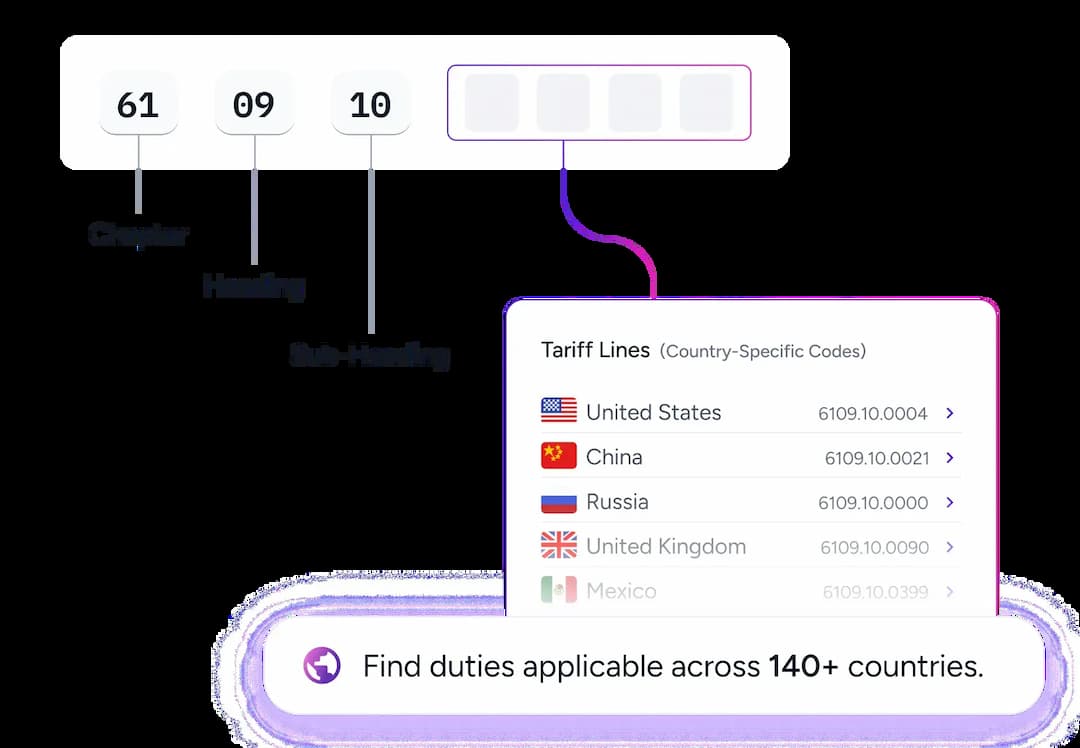
HS Code Lookup helps classify products under appropriate HS code and find duties applicable across 140+ countries. Find and discover HS classification, tariffs, taxes, controls, rulings, ECCNs, and default and preferential duties for HS code 841935.

Sub Heading 841935
Nuclear reactors, boilers, machinery and mechanical appliances; parts thereof - Machinery, plant or laboratory equipment, whether or not electrically heated (excluding furnaces, ovens and other equipment of heading 85.14), for the treatment of materials by a process involving a change of temperature such as heating, cooking, roasting, distilling, rectifying, sterilising, pasteurising, steaming, drying, evaporating, vaporising, condensing or cooling, other than machinery or plant of a kind used for domestic purposes; instantaneous or storage water heaters, non-electric. - Other, for wood, paper pulp, paper or paperboard
Select Country of Import to view its detailed HS
Select Country
Tariff Structure and Controls for HS Code 841935 in United States of America
HS Code & Description
8419351000
For wood
View Tariff & Duties
8419355000
Other
View Tariff & Duties
Most classified products under HS 841935
- Industrial Smelting Furnace - for melting and refining metals,
- Continuous Annealing Line - for heat treating steel in coil form,
- Rotary Kiln - for roasting of ores or pyrites,
- Electric Arc Furnace,
- Vacuum Induction Melting,
- Heat Treatment Oven - for hardening or tempering metals and
- Bell Annealing Furnace - for heat treating coils of wire or strip metals
Tariffs and Duties for HS 8419351000
General MFN Duty
| Duty Name | Origin | Duty Rate | Duty Type | Unit of Measurement | |
|---|---|---|---|---|---|
| Default Duty | All Countries | Free | Default Duty | UNIT | |
| Column2 Duty | All Countries | 35% | Additional Duty | - | |
 | China | | | - |

Accessing detailed Global Trade Compliance Content like Controls, Rulings, Tariffs, Duties etc requires a subscription to our platform.

FAQs
What is HS code 841935?

HS code 841935 includes Nuclear reactors, boilers, machinery and mechanical appliances; parts thereof - Machinery, plant or laboratory equipment, whether or not electrically heated (excluding furnaces, ovens and other equipment of heading 85.14), for the treatment of materials by a process involving a change of temperature such as heating, cooking, roasting, distilling, rectifying, sterilising, pasteurising, steaming, drying, evaporating, vaporising, condensing or cooling, other than machinery or plant of a kind used for domestic purposes; instantaneous or storage water heaters, non-electric. - Other, for wood, paper pulp, paper or paperboard.
What category is HS code 841935?
HS code 841935 belongs to chapter 84 Nuclear reactors, boilers, machinery and mechanical appliances; parts thereof category.
What is the duty for HS code 8419351000 in United States of America?
The default duty for 8419351000 in United States of America is Free. Find duties for other HS codes in United States of America.
How many dutiables are there in HS code 841935 in United States of America?
There are 2 dutiables in HS code 841935.
What is an HS Code and Why Does it Hold For Cross-Border Trade?
HS code is a standardized six-digit numerical classification system developed by the World Customs Organization (WCO) and acts as a universal language for simplifying the process of identifying and classifying traded products. They ensure consistent customs clearance, enable accurate duty calculation, and help identify relevant trade regulations. This simplifies the process for businesses, saving time, reducing risk, and promoting informed decision-making.
What are Controls and Why should Businesses Focus on Them?
In global trade, controls refer to a set of regulations and policies implemented by governments to manage the import and export of goods and services. These controls can take various forms, including tariffs, quotas, embargoes, export controls, and licensing requirements. Companies should prioritize understanding and adhering to them for compliance, reduced risk of legal issues, mitigating reputational damage, staying competitive, and building trust with governments.
What are Tariffs in Global Trade and Why should Businesses Focus on Them?
In global trade, tariffs are a type of tax levied by a government on imported goods. They act as a financial barrier to entry, increasing the overall cost of the imported product for domestic consumers and businesses. By understanding how tariffs work and their potential impact, companies can make informed decisions about pricing, sourcing, and market expansion, ultimately ensuring their competitiveness in the global marketplace.
What are FTAs in Global Trade and Why should Businesses Focus on Them?
In global trade, Free Trade Agreements (FTAs) are legally binding agreements between two or more countries aimed at reducing or eliminating barriers to trade between them. By understanding the terms of relevant FTAs and strategically incorporating them into their business plans, companies can enjoy reduced costs, expanded market access, and a more competitive edge in international trade.
International Trade Compliance Simplified
140+
Countries Covered
440+
Government Authorities
300+
FTAs Monitored
500K+
Customs Rulings
880K+
Import & Export Compliance Data Entities
APIs
Data License
Plans
Directories
Company
Location
United States
3000 El Camino Real, Building 4, Suite 200, Palo Alto, California 94306
India
2nd Floor, Plot No. 136, Sector 44, Gurugram, Haryana 122003






All rights reserved | Terms of use Copyright ©2025 Trademo Technologies Inc.