















HS Code Lookup for Chapter 87
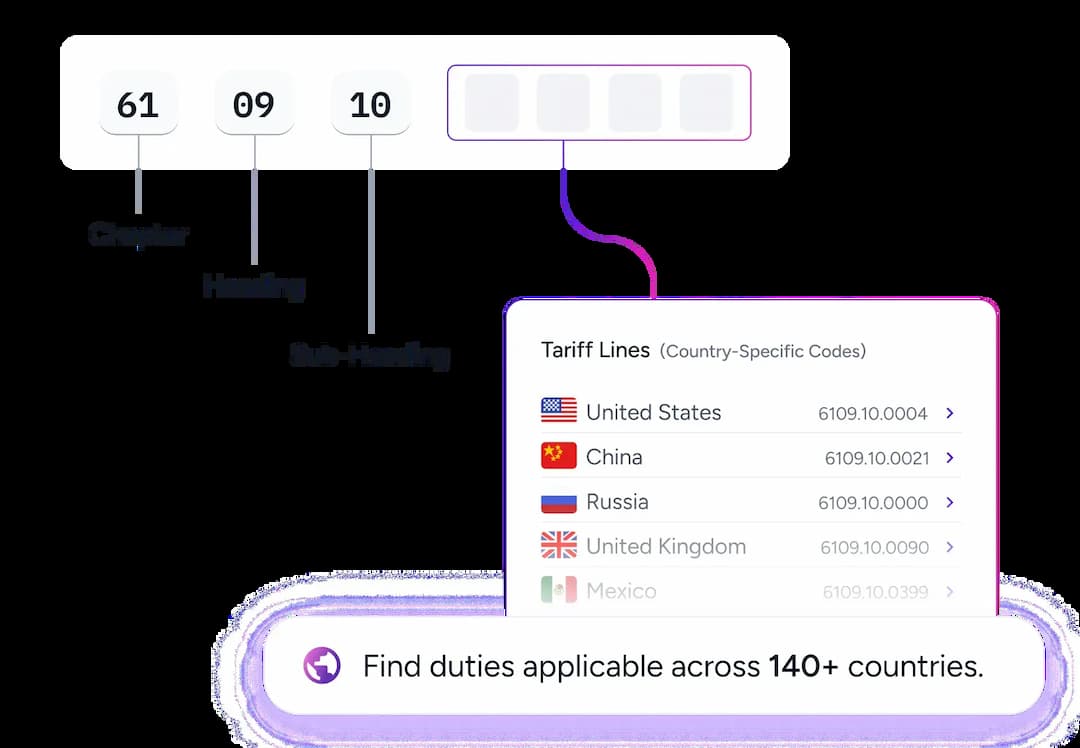
HS Code Lookup helps classify products under appropriate HS code and find duties applicable across 140+ countries. Find and discover HS classification, tariffs, taxes, controls, rulings, ECCNs, and default and preferential duties for HS code 87.

WCO Notes for Chapter 87
Chapter 87
Vehicles other than railway or tramway rolling‑stock, and parts and accessories thereof
Notes.
1.‑ This Chapter does not cover railway or tramway rolling-stock designed solely for running on rails.
2.‑ For the purposes of this Chapter, “tractors” means vehicles constructed essentially for hauling or pushing another vehicle, appliance or load, whether or not they contain subsidiary provision for the transport, in connection with the main use of the tractor, of tools, seeds, fertilisers or other goods.
Machines and working tools designed for fitting to tractors of heading 87.01 as interchangeable equipment remain classified in their respective headings even if presented with the tractor, and whether or not mounted on it.
3.‑ Motor chassis fitted with cabs fall in headings 87.02 to 87.04, and not in heading 87.06.
4.‑ Heading 87.12 includes all children’s bicycles. Other children’s cycles fall in heading 95.03.
Subheading Note.
1.‑ Subheading 8708.22 covers :
(a)- front windscreens (windshields), rear windows and other windows, framed; and
(b)- front windscreens (windshields), rear windows and other windows, whether or not framed, incorporating heating devices or other electrical or electronic devices,
when suitable for use solely or principally with the motor vehicles of headings 87.01 to 87.05.
GENERAL
This Chapter covers the following vehicles, with the exception of certain mobile machines of Section XVI (see the Explanatory Notes to headings 87.01, 87.05 and 87.16) :
(1) Tractors (heading 87.01).
(2) Motor vehicles designed for the transport of persons (heading 87.02 or 87.03) or goods (heading 87.04) or for special purposes (heading 87.05).
(3) Works trucks, self‑propelled, not fitted with lifting or handling equipment, of the type used in factories, warehouses, dock areas or airports for short distance transport of goods, and tractors of the type used on railway station platforms (heading 87.09).
(4) Armoured fighting vehicles, motorised (heading 87.10).
(5) Motorcycles and side-cars; cycles and carriages for disabled persons, whether or not motorised (headings 87.11 to 87.13).
(6) Baby carriages (heading 87.15).
(7) Trailers and semi‑trailers, and other vehicles, not mechanically propelled, i.e., vehicles for towing by another vehicle, pushing or pulling by hand or drawing by animals (heading 87.16).
The Chapter also covers air‑cushion vehicles designed to travel over land or over both land and certain tracts of water (swamps, etc.) (see Note 5 to Section XVII).
The classification of a motor vehicle is not affected by operations which are carried out after assembling all parts into a complete motor vehicle, such as : vehicle identification number fixation, brake system charging and bleeding air from brakes, charging of the steering booster system (power steering) and cooling and conditioning systems, headlights regulation, wheel geometry regulation (alignment) and regulation of brakes. This includes classification by the application of General Interpretative Rule 2 (a).
An incomplete or unfinished vehicle, whether or not assembled, is classified as the corresponding complete or finished vehicle provided it has the essential character of the latter (see General Interpretative Rule 2 (a)), as for example :
(A) A motor vehicle, not yet fitted with the wheels or tyres and battery.
(B) A motor vehicle not equipped with its engine or with its interior fittings.
(C) A bicycle without saddle and tyres.
This Chapter also covers parts and accessories which are identifiable as being suitable for use solely or principally with the vehicles included therein, subject to the provisions of the Notes to Section XVII (see the General Explanatory Note to the Section).
*
* *
It should be noted that amphibious motor vehicles are classified as motor vehicles of this Chapter. But aircraft specially constructed so that they can also be used as road vehicles remain classified as aircraft (heading 88.02).
The Chapter also excludes :
(a) Vehicles and parts thereof, cross‑sectioned, designed for demonstrational purposes, unsuitable for other uses (heading 90.23).
(b) Wheeled toys designed to be ridden by children, and children’s cycles (other than children’s bicycles) (heading 95.03).
(c) Winter sports equipment such as bobsleighs, toboggans and the like (heading 95.06).
(d) Vehicles specially designed for use on amusement park rides, or fairground amusements (heading 95.08).

What is HS code 87?

How many headings are there in HS code 87?
International Trade Compliance Simplified