





End-to-end compliance automation across classification, screening, and duties.










HS Code Lookup for Heading 8701
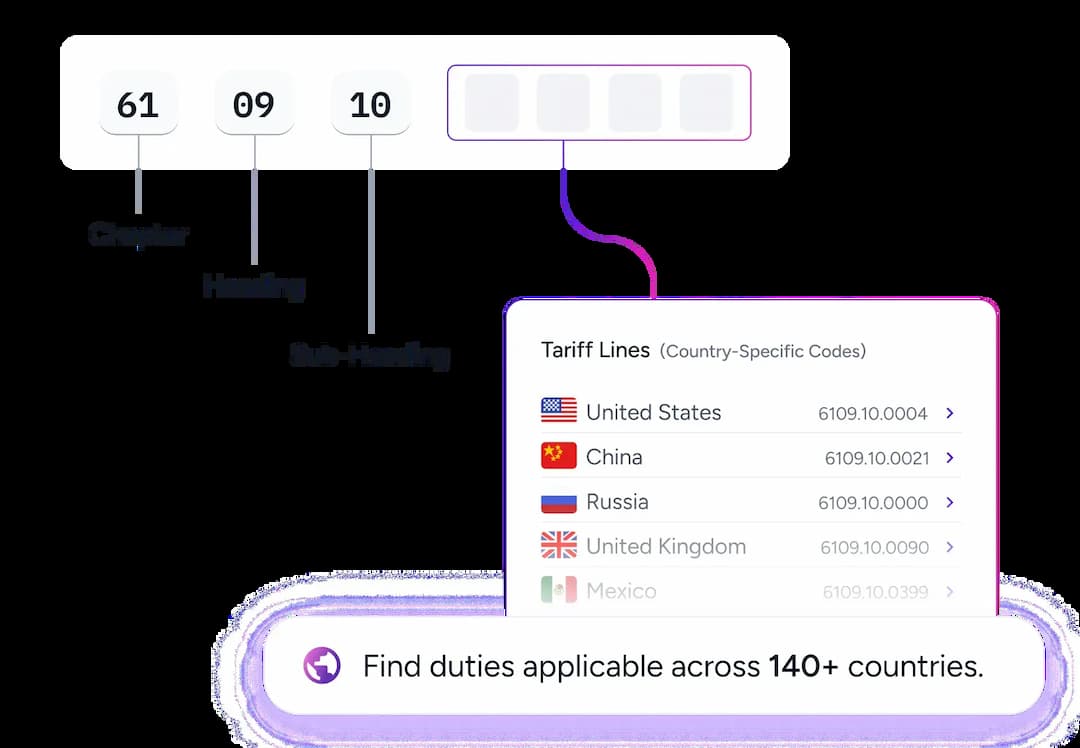
HS Code Lookup helps classify products under appropriate HS code and find duties applicable across 140+ countries. Find and discover HS classification, tariffs, taxes, controls, rulings, ECCNs, and default and preferential duties for HS code 8701.

WCO Notes for Heading 8701
87.01 ‑ Tractors (other than tractors of heading 87.09) (+).
8701.10 ‑ Single axle tractors
‑ Road tractors for semi-trailers :
8701.21 - ‑ With only compression-ignition internal combustion piston engine (diesel or semi-diesel)
8701.22 - ‑ With both compression-ignition internal combustion piston engine (diesel or semi-diesel) and electric motor as motors for propulsion
8701.23 - ‑ With both spark-ignition internal combustion piston engine and electric motor as motors for propulsion
8701.24 - ‑ With only electric motor for propulsion
8701.29 - ‑ Other
8701.30 ‑ Track‑laying tractors
‑ Other, of an engine power :
8701.91 - ‑ Not exceeding 18 kW
8701.92 - ‑ Exceeding 18 kW but not exceeding 37 kW
8701.93 - ‑ Exceeding 37 kW but not exceeding 75 kW
8701.94 - ‑ Exceeding 75 kW but not exceeding 130 kW
8701.95 - ‑ Exceeding 130 kW
For the purposes of this heading, tractors means wheeled or track‑laying vehicles constructed essentially for hauling or pushing another vehicle, appliance or load. They may contain subsidiary provision for the transport, in connection with the main use of the tractor, of tools, seeds, fertilisers or other goods, or provision for fitting with working tools as a subsidiary function.
The heading does not cover propelling bases specially designed, constructed or reinforced to form an integral part of a machine performing a function such as lifting, excavating, levelling, etc., even if the propelling base uses traction or propulsion for the execution of this function.
The heading covers tractors (other than tractors of the type used on railway station platforms, falling in heading 87.09) of various types (tractors for agricultural or forestry work, road tractors, heavy duty tractors for constructional engineering work, winch tractors, etc.), whatever their mode of propulsion (internal combustion piston engine, electric motor, etc.). It also includes tractors which can be used both on rails and on road, but not those which are designed exclusively for use on rails.
The tractors of this heading may be fitted with coachwork (a body) or may have seats for the crew or a driving cab. They may be equipped with a tool box, with provision for raising and lowering agricultural implements, with a coupling device for trailers or semi‑trailers (e.g., on mechanical horses and similar tractive units), or with a power take‑off for driving machines such as threshers and circular saws.
The chassis of a tractor may be mounted on wheels, on tracks or on a combination of wheels and tracks. In the last case, only the front steering axle is fitted with wheels.
This heading also covers single axle tractors. These are small agricultural tractors equipped with a single driving axle carried on one or two wheels; like normal tractors, they are designed for use with interchangeable implements which they may operate by means of a general purpose power take‑off. They are not usually fitted with a seat and the steering is effected by means of two handles. Some types, however, also have a one‑ or two‑wheeled rear carriage with a seat for the driver.
Similar single axle tractorsare also used for industrial purposes.
The heading includes tractors fitted with winches (e.g., as used for hauling out bogged‑down vehicles; for up‑rooting and hauling trees; or for the remote haulage of agricultural implements).
The heading further includes straddle‑type tractors (stilt tractors) used, for example, in vineyards and forestry plantations.
*
* *
*
* *
The heading also excludes motor breakdown lorries equipped with cranes, lifting tackle, winches, etc. (heading 87.05).
TRACTORS FITTED WITH OTHER MACHINERY
It should be noted that agricultural machines designed for fitting to tractors as interchangeable equipment (ploughs, harrows, hoes, etc.) remain classified in their respective headings even if mounted on the tractor at the time of presentation. The tractive unit in such cases is separately classified in this heading.
Tractors and industrial working tools are also classified separately when the tractor is designed essentially for hauling or pushing another vehicle or load, and includes, in the same way as an agricultural tractor, simple devices for operating (raising, lowering, etc.) the working tools. In such a case, the interchangeable working tools are classified in their appropriate headings, even if presented with the tractor, and whether or not mounted on it, while the tractor with its operating equipment is classified in this heading.
In the case of articulated motor lorries with semi‑trailers, tractors coupled to semi‑trailers, and heavy duty tractors coupled, in the same way as to semi‑trailers, to working machines of Chapter 84, the hauling element is classified in this heading whereas the semi‑trailer or the working machine is classified in its appropriate heading.
On the other hand, this heading does not cover the propelling bases of machines referred to, for example, in headings 84.25, 84.26, 84.29, 84.30 and 84.32, in which the propelling base, the operating controls, the working tools and their actuating equipment are specially designed for fitting together to form an integral mechanical unit. Such is the case with loaders, bulldozers, motorised ploughs, etc.
As a general rule, propelling bases forming an integral part of a machine designed for handling, excavating, etc., can be distinguished from the tractors of this heading by their special constructional features (shape, chassis, means of locomotion, etc.). For propelling bases of the tractor type, various technical features relating essentially to the structure of the complete unit and to equipment specially designed for functions other than hauling or pushing should be taken into consideration. For instance, the propelling bases not covered by this heading incorporate robust elements (such as supporting blocks, plates or beams, platforms for swivelling cranes) forming a part of or fixed, generally by welding, to the chassis‑body framework to carry the actuating equipment for the working tools. In addition, such propelling bases may comprise several of the following typical parts : powerful equipment with built‑in hydraulic system for operating the working tools; special gear boxes, in which, for example, the top speed in reverse gear is not less than the top speed in forward gear; hydraulic clutch and torque converter; balancing counterweight; longer tracks to increase stability of the base; special frame for rear mounted engine, etc.
°
° °
Subheading Explanatory Notes.
Subheading 8701.10
See the Explanatory Note to heading 87.01, sixth and seventh paragraphs.
Subheading 8701.20
For the purposes of this subheading, the expression “road tractors” refers to motor vehicles which are designed to haul semi-trailers over long distances. The road tractor and semi-trailer form a combination known by various names (e.g., “articulated lorries”, “tractor-trailers”, etc.). These vehicles usually contain diesel engines and may be driven at speeds in excess of urban traffic speeds on the road network (i.e., streets in the general sense, including avenues, boulevards and motorways) with fully loaded trailers. Such vehicles have a closed cab for the driver and passengers (sometimes with sleeping facilities), headlamps and dimensions authorized domestically, and are usually equipped with a fifth wheel coupling allowing rapid shift between semi-trailers performing different functions.
Similar vehicles used to haul semi-trailers over short distances are excluded from this subheading (generally subheadings8701.91 to8701.95).
Subheading 8701.30
This subheading also covers tractors with a combination of wheels and tracks.
Subheadings 8701.91 to 8701.95
87.01 ‑ Tractors (other than tractors of heading 87.09) (+).
8701.10 ‑ Single axle tractors
‑ Road tractors for semi-trailers :
8701.21 - ‑ With only compression-ignition internal combustion piston engine (diesel or semi-diesel)
8701.22 - ‑ With both compression-ignition internal combustion piston engine (diesel or semi-diesel) and electric motor as motors for propulsion
8701.23 - ‑ With both spark-ignition internal combustion piston engine and electric motor as motors for propulsion
8701.24 - ‑ With only electric motor for propulsion
8701.29 - ‑ Other
8701.30 ‑ Track‑laying tractors
‑ Other, of an engine power :
8701.91 - ‑ Not exceeding 18 kW
8701.92 - ‑ Exceeding 18 kW but not exceeding 37 kW
8701.93 - ‑ Exceeding 37 kW but not exceeding 75 kW
8701.94 - ‑ Exceeding 75 kW but not exceeding 130 kW
8701.95 - ‑ Exceeding 130 kW
For the purposes of this heading, tractors means wheeled or track‑laying vehicles constructed essentially for hauling or pushing another vehicle, appliance or load. They may contain subsidiary provision for the transport, in connection with the main use of the tractor, of tools, seeds, fertilisers or other goods, or provision for fitting with working tools as a subsidiary function.
The heading does not cover propelling bases specially designed, constructed or reinforced to form an integral part of a machine performing a function such as lifting, excavating, levelling, etc., even if the propelling base uses traction or propulsion for the execution of this function.
The heading covers tractors (other than tractors of the type used on railway station platforms, falling in heading 87.09) of various types (tractors for agricultural or forestry work, road tractors, heavy duty tractors for constructional engineering work, winch tractors, etc.), whatever their mode of propulsion (internal combustion piston engine, electric motor, etc.). It also includes tractors which can be used both on rails and on road, but not those which are designed exclusively for use on rails.
The tractors of this heading may be fitted with coachwork (a body) or may have seats for the crew or a driving cab. They may be equipped with a tool box, with provision for raising and lowering agricultural implements, with a coupling device for trailers or semi‑trailers (e.g., on mechanical horses and similar tractive units), or with a power take‑off for driving machines such as threshers and circular saws.
The chassis of a tractor may be mounted on wheels, on tracks or on a combination of wheels and tracks. In the last case, only the front steering axle is fitted with wheels.
This heading also covers single axle tractors. These are small agricultural tractors equipped with a single driving axle carried on one or two wheels; like normal tractors, they are designed for use with interchangeable implements which they may operate by means of a general purpose power take‑off. They are not usually fitted with a seat and the steering is effected by means of two handles. Some types, however, also have a one‑ or two‑wheeled rear carriage with a seat for the driver.
Similar single axle tractorsare also used for industrial purposes.
The heading includes tractors fitted with winches (e.g., as used for hauling out bogged‑down vehicles; for up‑rooting and hauling trees; or for the remote haulage of agricultural implements).
The heading further includes straddle‑type tractors (stilt tractors) used, for example, in vineyards and forestry plantations.
*
* *
*
* *
The heading also excludes motor breakdown lorries equipped with cranes, lifting tackle, winches, etc. (heading 87.05).
TRACTORS FITTED WITH OTHER MACHINERY
It should be noted that agricultural machines designed for fitting to tractors as interchangeable equipment (ploughs, harrows, hoes, etc.) remain classified in their respective headings even if mounted on the tractor at the time of presentation. The tractive unit in such cases is separately classified in this heading.
Tractors and industrial working tools are also classified separately when the tractor is designed essentially for hauling or pushing another vehicle or load, and includes, in the same way as an agricultural tractor, simple devices for operating (raising, lowering, etc.) the working tools. In such a case, the interchangeable working tools are classified in their appropriate headings, even if presented with the tractor, and whether or not mounted on it, while the tractor with its operating equipment is classified in this heading.
In the case of articulated motor lorries with semi‑trailers, tractors coupled to semi‑trailers, and heavy duty tractors coupled, in the same way as to semi‑trailers, to working machines of Chapter 84, the hauling element is classified in this heading whereas the semi‑trailer or the working machine is classified in its appropriate heading.
On the other hand, this heading does not cover the propelling bases of machines referred to, for example, in headings 84.25, 84.26, 84.29, 84.30 and 84.32, in which the propelling base, the operating controls, the working tools and their actuating equipment are specially designed for fitting together to form an integral mechanical unit. Such is the case with loaders, bulldozers, motorised ploughs, etc.
As a general rule, propelling bases forming an integral part of a machine designed for handling, excavating, etc., can be distinguished from the tractors of this heading by their special constructional features (shape, chassis, means of locomotion, etc.). For propelling bases of the tractor type, various technical features relating essentially to the structure of the complete unit and to equipment specially designed for functions other than hauling or pushing should be taken into consideration. For instance, the propelling bases not covered by this heading incorporate robust elements (such as supporting blocks, plates or beams, platforms for swivelling cranes) forming a part of or fixed, generally by welding, to the chassis‑body framework to carry the actuating equipment for the working tools. In addition, such propelling bases may comprise several of the following typical parts : powerful equipment with built‑in hydraulic system for operating the working tools; special gear boxes, in which, for example, the top speed in reverse gear is not less than the top speed in forward gear; hydraulic clutch and torque converter; balancing counterweight; longer tracks to increase stability of the base; special frame for rear mounted engine, etc.
°
° °
Subheading Explanatory Notes.
Subheading 8701.10
See the Explanatory Note to heading 87.01, sixth and seventh paragraphs.
Subheading 8701.20Subheadings 8701.21 to 8701.29
For the purposes of this subheadingthese subheadings, the expression “road tractors” refers to motor vehicles which are designed to haul semi-trailers over long distances. The road tractor and semi-trailer form a combination known by various names (e.g., “articulated lorries”, “tractor-trailers”, etc.). These vehicles usually contain diesel engines and may be driven at speeds in excess of urban traffic speeds on the road network (i.e., streets in the general sense, including avenues, boulevards and motorways) with fully loaded trailers. Such vehicles have a closed cab for the driver and passengers (sometimes with sleeping facilities), headlamps and dimensions authorized domestically, and are usually equipped with a fifth wheel coupling allowing rapid shift between semi-trailers performing different functions.
Similar vehicles used to haul semi-trailers over short distances are excluded from this subheadingthese subheadings (generally subheadings8701.91subheadings 8701.91 to8701.95).
Subheading 8701.30
This subheading also covers tractors with a combination of wheels and tracks.
Subheadings 8701.91 to 8701.95
87.01 ‑ Tractors (other than tractors of heading 87.09) (+).
8701.10 ‑ Single axle tractors
‑ Road tractors for semi-trailers :
8701.21 - ‑ With only compression-ignition internal combustion piston engine (diesel or semi-diesel)
8701.22 - ‑ With both compression-ignition internal combustion piston engine (diesel or semi-diesel) and electric motor as motors for propulsion
8701.23 - ‑ With both spark-ignition internal combustion piston engine and electric motor as motors for propulsion
8701.24 - ‑ With only electric motor for propulsion
8701.29 - ‑ Other
8701.30 ‑ Track‑laying tractors
‑ Other, of an engine power :
8701.91 - ‑ Not exceeding 18 kW
8701.92 - ‑ Exceeding 18 kW but not exceeding 37 kW
8701.93 - ‑ Exceeding 37 kW but not exceeding 75 kW
8701.94 - ‑ Exceeding 75 kW but not exceeding 130 kW
8701.95 - ‑ Exceeding 130 kW
For the purposes of this heading, tractors means wheeled or track‑laying vehicles constructed essentially for hauling or pushing another vehicle, appliance or load. They may contain subsidiary provision for the transport, in connection with the main use of the tractor, of tools, seeds, fertilisers or other goods, or provision for fitting with working tools as a subsidiary function.
The heading does not cover propelling bases specially designed, constructed or reinforced to form an integral part of a machine performing a function such as lifting, excavating, levelling, etc., even if the propelling base uses traction or propulsion for the execution of this function.
The heading covers tractors (other than tractors of the type used on railway station platforms, falling in heading 87.09) of various types (tractors for agricultural or forestry work, road tractors, heavy duty tractors for constructional engineering work, winch tractors, etc.), whatever their mode of propulsion (internal combustion piston engine, electric motor, etc.). It also includes tractors which can be used both on rails and on road, but not those which are designed exclusively for use on rails.
The tractors of this heading may be fitted with coachwork (a body) or may have seats for the crew or a driving cab. They may be equipped with a tool box, with provision for raising and lowering agricultural implements, with a coupling device for trailers or semi‑trailers (e.g., on mechanical horses and similar tractive units), or with a power take‑off for driving machines such as threshers and circular saws.
The chassis of a tractor may be mounted on wheels, on tracks or on a combination of wheels and tracks. In the last case, only the front steering axle is fitted with wheels.
This heading also covers single axle tractors. These are small agricultural tractors equipped with a single driving axle carried on one or two wheels; like normal tractors, they are designed for use with interchangeable implements which they may operate by means of a general purpose power take‑off. They are not usually fitted with a seat and the steering is effected by means of two handles. Some types, however, also have a one‑ or two‑wheeled rear carriage with a seat for the driver.
Similar single axle tractorsare also used for industrial purposes.
The heading includes tractors fitted with winches (e.g., as used for hauling out bogged‑down vehicles; for up‑rooting and hauling trees; or for the remote haulage of agricultural implements).
The heading further includes straddle‑type tractors (stilt tractors) used, for example, in vineyards and forestry plantations.
*
* *
*
* *
The heading also excludes motor breakdown lorries equipped with cranes, lifting tackle, winches, etc. (heading 87.05).
TRACTORS FITTED WITH OTHER MACHINERY
It should be noted that agricultural machines designed for fitting to tractors as interchangeable equipment (ploughs, harrows, hoes, etc.) remain classified in their respective headings even if mounted on the tractor at the time of presentation. The tractive unit in such cases is separately classified in this heading.
Tractors and industrial working tools are also classified separately when the tractor is designed essentially for hauling or pushing another vehicle or load, and includes, in the same way as an agricultural tractor, simple devices for operating (raising, lowering, etc.) the working tools. In such a case, the interchangeable working tools are classified in their appropriate headings, even if presented with the tractor, and whether or not mounted on it, while the tractor with its operating equipment is classified in this heading.
In the case of articulated motor lorries with semi‑trailers, tractors coupled to semi‑trailers, and heavy duty tractors coupled, in the same way as to semi‑trailers, to working machines of Chapter 84, the hauling element is classified in this heading whereas the semi‑trailer or the working machine is classified in its appropriate heading.
On the other hand, this heading does not cover the propelling bases of machines referred to, for example, in headings 84.25, 84.26, 84.29, 84.30 and 84.32, in which the propelling base, the operating controls, the working tools and their actuating equipment are specially designed for fitting together to form an integral mechanical unit. Such is the case with loaders, bulldozers, motorised ploughs, etc.
As a general rule, propelling bases forming an integral part of a machine designed for handling, excavating, etc., can be distinguished from the tractors of this heading by their special constructional features (shape, chassis, means of locomotion, etc.). For propelling bases of the tractor type, various technical features relating essentially to the structure of the complete unit and to equipment specially designed for functions other than hauling or pushing should be taken into consideration. For instance, the propelling bases not covered by this heading incorporate robust elements (such as supporting blocks, plates or beams, platforms for swivelling cranes) forming a part of or fixed, generally by welding, to the chassis‑body framework to carry the actuating equipment for the working tools. In addition, such propelling bases may comprise several of the following typical parts : powerful equipment with built‑in hydraulic system for operating the working tools; special gear boxes, in which, for example, the top speed in reverse gear is not less than the top speed in forward gear; hydraulic clutch and torque converter; balancing counterweight; longer tracks to increase stability of the base; special frame for rear mounted engine, etc.
°
° °
Subheading Explanatory Notes.
Subheading 8701.10
See the Explanatory Note to heading 87.01, sixth and seventh paragraphs.
Subheadings 8701.21 to 8701.29
For the purposes of these subheadings, the expression “road tractors” refers to motor vehicles which are designed to haul semi-trailers over long distances. The road tractor and semi-trailer form a combination known by various names (e.g., “articulated lorries”, “tractor-trailers”, etc.). These vehicles usually contain diesel engines and may be driven at speeds in excess of urban traffic speeds on the road network (i.e., streets in the general sense, including avenues, boulevards and motorways) with fully loaded trailers. Such vehicles have a closed cab for the driver and passengers (sometimes with sleeping facilities), headlamps and dimensions authorized domestically, and are usually equipped with a fifth wheel coupling allowing rapid shift between semi-trailers performing different functions.
Similar vehicles used to haul semi-trailers over short distances are excluded from these subheadings (generally subheadings 8701.91 to8701.95).
Subheading 8701.30
This subheading also covers tractors with a combination of wheels and tracks.
Subheadings 8701.91 to 8701.95

What is HS code 8701?

How many sub-headings are there in HS code 8701?
International Trade Compliance Simplified